
Community Event Invitations for Corvette Cruises and Reunions
The best community event invitations do more than announce a date. For a Corvette cruise, reunion, or regional gathering, the invitation should tell people what kind of day they are joining, what their car needs, where they must be, and how to respond. It should also look worth saving. Before printing, confirm the venue, route, permit timetable, attendance limit, and rain plan. Then build one clear invitation around those settled details.
That order matters. A handsome card cannot rescue an uncertain meeting point or an unapproved road closure. If major arrangements are still moving, send a simple save-the-date first. Reserve the finished invitation for the point when members can trust the instructions.
Settle the event before designing the card
Start with a one-page event brief shared among the organizers. Record the event name, date, start and finish times, primary location, cruise destination, expected attendance, registration method, cost, accessibility considerations, and responsible contact. For a driving event, add the approximate mileage, planned stops, fuel expectations, and what happens if a participant becomes separated from the group. Our guides to building a Corvette-friendly Poconos route and planning fuel stops for a club drive can help settle those details before they reach the invitation.
Public-space and road arrangements need attention well ahead of the print deadline. Easton’s published special-event information calls for applications at least 45 days before an event and requires an insurance certificate naming the city as an additional insured after approval. Its planning materials also address site plans, emergency access, road closures, communications, and crowd management for covered events. Review the City of Easton’s special-event information for the requirements that apply to the proposed gathering.
A cruise involving state roads can require a different process from one confined to local roads. PennDOT’s special-event guidance calls for a completed application and supporting documents eight weeks before an event using state roads, including relevant municipal notices or approval letters. Treat that as a conservative planning milestone rather than waiting until invitations are ready to mail. PennDOT’s special-event guidance explains the state-road process.
Choose the invitation channel for the audience
A club reunion and a public car show may use the same artwork but need different distribution. Named members are best reached through addressed mail, email, or both. A neighborhood open house may justify broader route-based mail. A public show also needs calendar listings and shareable digital information. One format rarely does every job well.
| Channel | Best use | Watch for |
|---|---|---|
| Addressed postcard | Member lists, former members, invited clubs | Keep the mailing list current and leave room for postal markings. |
| Folded invitation or card | Reunions, banquets, commemorative gatherings | Allow more production time and confirm the finished mailing classification. |
| Every Door Direct Mail | Public events aimed at selected neighborhoods | It reaches carrier routes rather than named recipients and starts at 200 pieces. |
| Email or event page | Updates, RSVP links, weather notices | Do not assume every longtime member regularly checks digital messages. |
| Regional event calendar | Public-facing Lehigh Valley gatherings | Check geographic eligibility, exclusions, lead time, and required event details. |
USPS Every Door Direct Mail uses carrier routes and addresses pieces to “Postal Customer” rather than to individuals. EDDM Retail has a 200-piece minimum and permits up to 5,000 pieces per day per ZIP Code, making it a possible choice for a genuinely public event but a poor substitute for a club roster. USPS also requires qualifying dimensions and prescribed indicia placement, so check the finished piece before production. USPS Every Door Direct Mail guidance provides the current route-selection and preparation rules.
For ordinary mailed postcards, USPS defines the postcard-price dimensions as rectangular, at least 3.5 by 5 inches and no more than 4.25 by 6 inches, subject to thickness and other eligibility requirements. A larger single-panel invitation may be charged at letter pricing. Magnets, stickers, and other attachments can also change eligibility or postage, so confirm the assembled piece rather than pricing postage from the card alone. USPS postcard standards should be checked before the print order is approved.
Give drivers the details they will actually use
A Corvette event invitation should answer the practical questions in one scan. Include the full date and day of the week, arrival window, drivers’ meeting time, departure time, street address, RSVP deadline, fee if any, and one reliable contact. State whether the gathering is open to the public, limited to registered drivers, or intended for members and guests.
- Name the exact meeting location, not merely the town or shopping center.
- Say whether participants need a full fuel tank at arrival and estimate the cruise distance.
- Explain whether all Corvette generations, other vehicles, or spectators are welcome.
- Provide a short rain, postponement, or cancellation policy and identify the update channel.
- Mention registration limits, passenger charges, meal arrangements, and accessibility details when applicable.
- Put route maps, detailed rules, and emergency instructions on a separate handout or event page if they would overcrowd the invitation.
If the day includes a raffle or drawing, do not casually add it as a decorative fundraising line. Pennsylvania classifies raffles and several related drawings as Small Games of Chance and states that a license is required for those activities. Confirm the organization’s eligibility and the applicable rules before promoting one.
Use Corvette character without sacrificing clarity
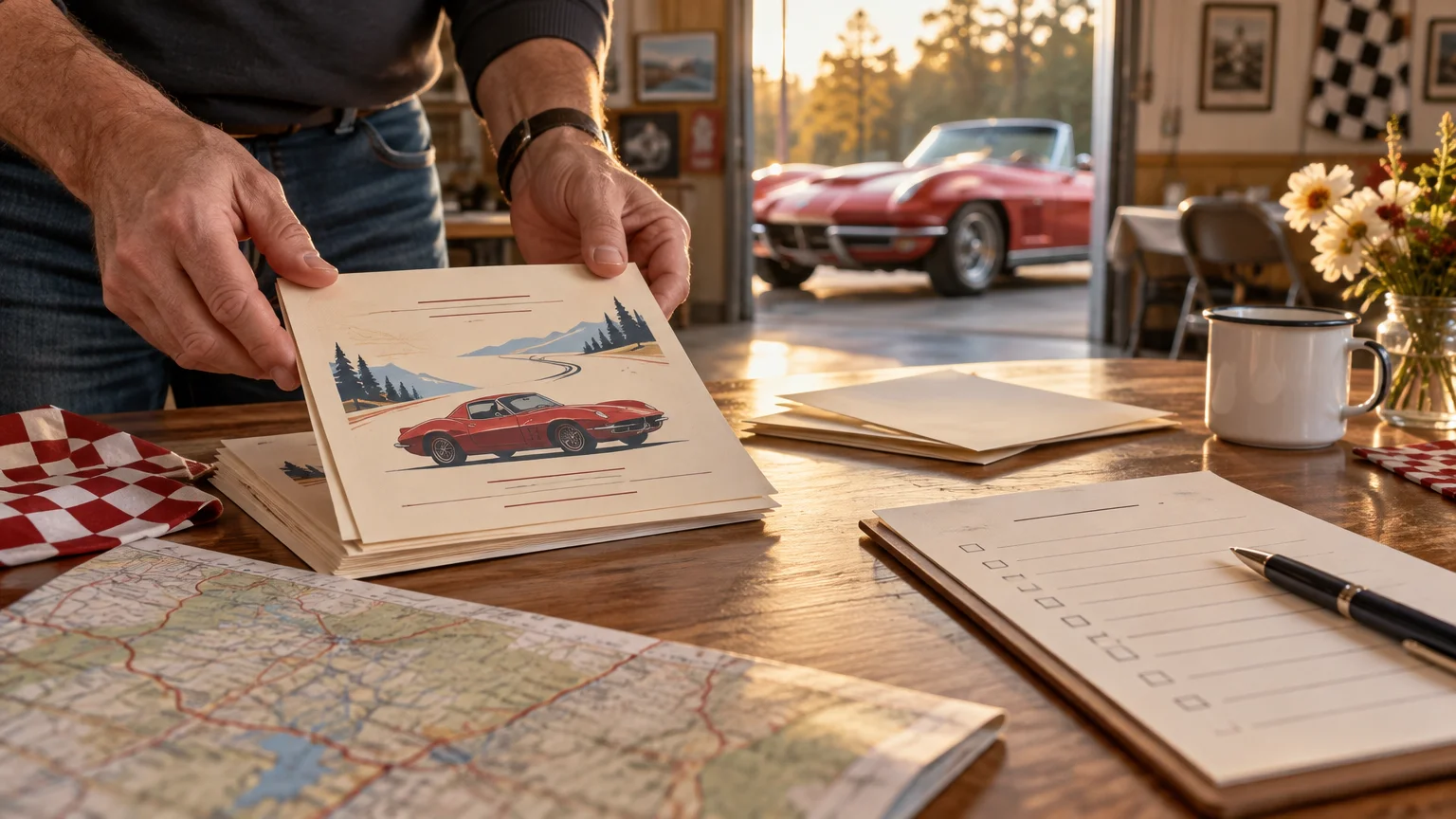
The invitation can carry some club history without becoming a museum label. An old emblem, a faded cruise badge, a period photograph, or a simplified outline of a familiar Corvette generation can establish the mood. Keep the event name and essential logistics stronger than the decoration. Small script type and low-contrast photographs may feel nostalgic on a monitor but become troublesome when printed at postcard size.
When adapting an archived emblem, work from the cleanest available original and preserve an untouched scan. Rebuild damaged lettering carefully instead of repeatedly tracing a degraded copy. If the design will continue onto a commemorative decal, our guide to reproducing historic club bumper-sticker artwork covers the separate material and documentation decisions. The invitation and sticker can share a visual language without forcing one file to perform both jobs.
Before ordering, print the design at actual size on an ordinary office printer. Read it from arm’s length, circle anything that takes effort to find, and ask someone uninvolved with planning to identify the date, destination, departure time, and RSVP method. That small test catches more useful problems than admiring a full-screen proof. When the occasion calls for a mailed keepsake, compare printed invitation, stationery, and card production options only after the final dimensions, quantity, paper choice, and mailing method are known.
Build a schedule backward from the event
For a larger cruise or reunion, begin roughly 10 to 12 weeks out. Confirm the organizing team, venue, tentative route, permit needs, insurance questions, and attendance model. By eight weeks, submit any applicable state-road materials and lock the invitation copy. Around six to seven weeks, approve the proof and prepare the mailing list. Mail early enough to give recipients a useful response window, then send a digital reminder closer to the event. Local requirements, production times, and postal delivery can change that schedule, so add breathing room rather than treating the final mailing date as a target to race.
If the gathering is open to the public in Lehigh or Northampton County, Discover Lehigh Valley accepts eligible event submissions with the date, location, description, image, and event website information. Its guidance asks for submission at least three business days ahead, but earlier promotion is more useful, and some event types are excluded. A public calendar is a visibility channel, not a replacement for direct invitations to former members or neighboring clubs. Discover Lehigh Valley’s event submission guidance lists the current criteria.
Save one invitation for the next generation
After the cruise or reunion, keep one clean invitation with the source artwork, final mailing file, event date, venue information, distribution notes, and a few labeled photographs. The Library of Congress includes items such as handbills, newsletters, posters, and related short-lived publications within ephemera, emphasizing appropriate storage, environment, and handling as the sound basis for preserving paper material.
That may feel like extra paperwork after the last Corvette has left the lot, but it is how a community event becomes part of a usable club record. Settle the logistics first, print a card people can understand, and preserve a copy afterward. Years from now, the route may change and the cars may belong to different caretakers, but a well-made invitation will still show who gathered, where they went, and why the day mattered.
Frequently Asked Questions
What information belongs on a Corvette cruise invitation?
Include the full date, arrival window, drivers’ meeting and departure times, exact address, RSVP deadline, fee, attendance rules, rain policy, and a reliable contact. Add estimated mileage and fuel expectations for a cruise.
Should organizers send a save-the-date or a finished invitation?
Send a save-the-date while major arrangements are still moving. Mail the finished invitation only after the venue, route, permits, attendance limit, and response method are dependable.
How early should permit planning begin in Easton?
Easton says special-event applications must arrive at least 45 days before the event. Covered events may also require planning for insurance, site layout, emergency access, road closures, communications, and crowd management.
What if a Corvette cruise uses Pennsylvania state roads?
PennDOT’s special-event materials specify submitting the completed application and supporting documents eight weeks ahead when the applicable process involves state roads. Treat that as a planning milestone, not the week to begin designing the card.
Is Every Door Direct Mail suitable for a club reunion?
Usually not for a members-only reunion. EDDM reaches carrier routes as “Postal Customer,” with a 200-piece retail minimum, so addressed mail or email is better for named members and former members.
Can an invitation advertise a raffle?
Only after confirming that the organization and activity meet Pennsylvania requirements. The state classifies raffles and several related drawings as Small Games of Chance and says a license is required.
References
- 4/16/2021CITY OF EASTON
- www.pa.gov
- Special Event Permit
- Library of Congress Collections Policy Statements: Ephemera
- www.easton-pa.com
- Every Door Direct Mail (EDDM) – Targeted Mail Marketing | USPS
- Sizes for Postcards | Postal Explorer
- Small Games of Chance Permit (drawings, lotteries, and raffles)
- Share Your Event | Discover Lehigh Valley
- Lehigh Valley Events | Festivals, Exhibits & Performances | Discover Lehigh Valley