How to Build Fuel Stops Into a Club Route
TLDR: Plan Corvette club fuel stops as formal regrouping points, not improvised reactions to a low-fuel warning. Ask everyone to arrive with a full tank, base the first stop on the least comfortable range in the group, and choose a station with easy access, enough pumps, restrooms, and somewhere to gather away from the fueling lanes. Give every driver the next waypoint and a backup location before departure.
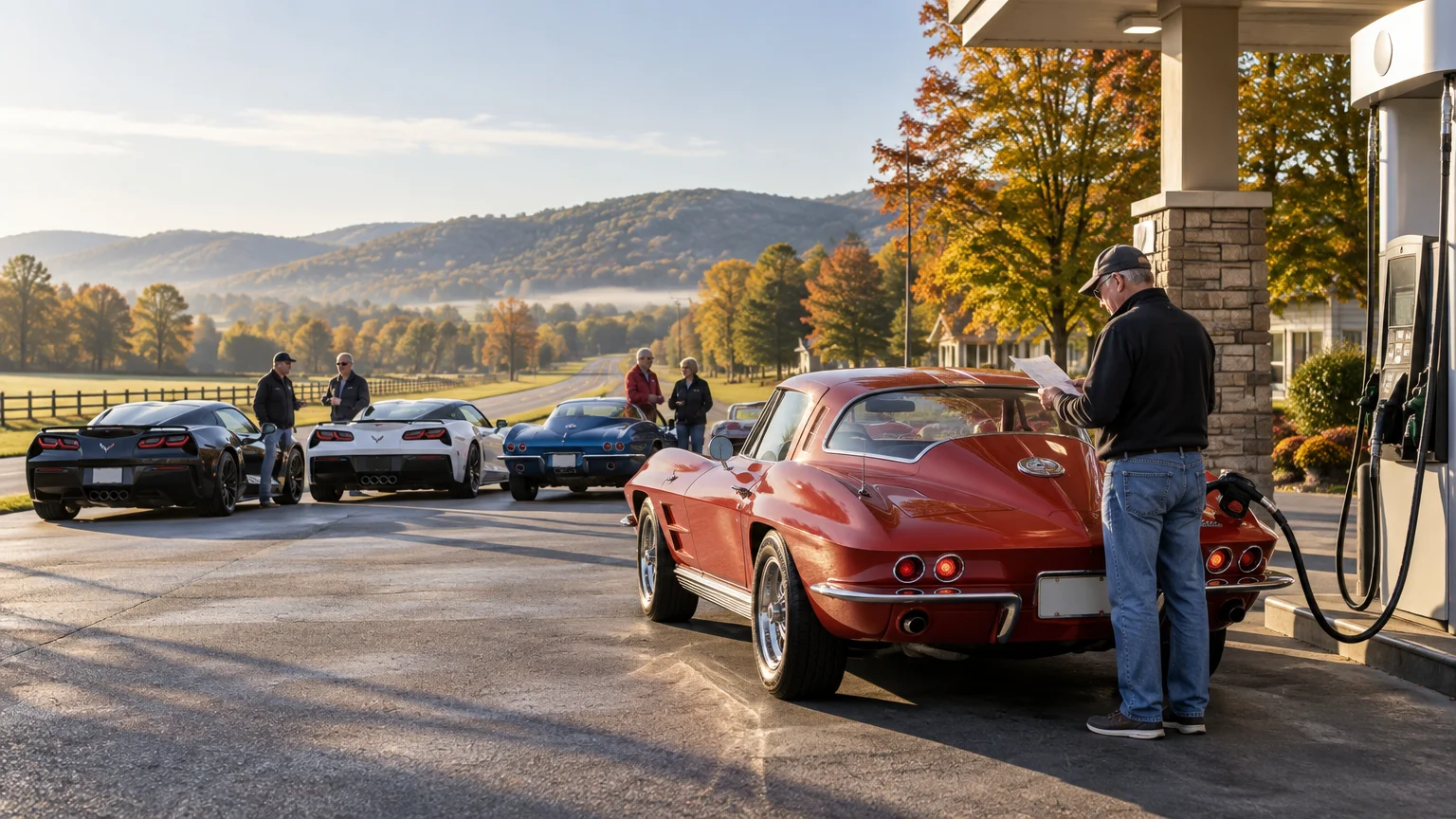
Good Corvette club fuel stops are nearly invisible when they work. Cars enter without a difficult turn, drivers fuel or use the restroom, the group reforms, and the cruise continues. A poor stop can scatter the same group across traffic lights, trap low cars on a steep entrance, and leave half the drivers wondering whether the lead car has already departed.
The useful answer is to build each stop into the route before publishing it. Assign lead and sweep drivers, set a departure window rather than an exact minute, and make sure no participant must chase the convoy. That structure matters when a cruise includes everything from an older small-block Corvette with an unfamiliar fuel gauge to a newer car showing a detailed range estimate.
Plan around the least comfortable car
Do not calculate the route from the theoretical maximum range of the newest Corvette attending. Ask participants for a practical comfort range instead. That is the distance at which the driver would prefer to stop under ordinary conditions, with a reserve for congestion, a missed turn, or a closed pump.
Comfort range is deliberately conservative. It accounts for the owner who does not trust an older gauge below one-quarter, the restored car whose driver wants a quick inspection after an hour, and the passenger who appreciates a restroom break. It also avoids pretending that one fuel-consumption figure applies across eight Corvette generations, different engines, and decades of modification.
Every owner should follow the fuel requirements in the manual or other reliable documentation for that particular model and powertrain. The organizer’s job is to identify suitable stops, not to prescribe one grade for every Corvette.
| Planning decision | Practical rule | What to publish |
|---|---|---|
| Starting fuel | Ask every driver to arrive fueled and ready | Whether fuel is available at or near the assembly point |
| First stop | Place it inside the least comfortable range reported by the group | Station name, address, entrance direction, and approximate distance |
| Stop duration | Use a window that allows fueling and a restroom visit | Arrival estimate and earliest departure time |
| Regrouping | Gather away from pumps and store entrances | Exact area where cars should reform |
| Communication | Give instructions before the engines start | Lead and sweep contacts plus the next waypoint |
| Backup | Choose a second usable station or meeting point | Name, address, and conditions for using it |
A pre-drive mechanical check remains separate from route planning. Tires, fluids, lights, battery condition, and emergency supplies deserve attention before the car reaches the starting line. The Corvette road trip checklist offers a useful preparation sequence for owners.
How to choose Corvette club fuel stops
A familiar brand or attractive price is not enough. Approach and departure matter more to a convoy. Review the entrance from the direction of travel and look for steep transitions, broken pavement, narrow lanes, raised curbs, and turns that require the entire group to cross fast traffic.
Then consider capacity. A small station may be perfectly adequate for six cars but frustrating for twenty. Count usable pump positions conservatively, remembering that other customers will be present. Look for a legal waiting area that does not block pumps, accessible spaces, fire lanes, store doors, or the path used by delivery trucks.
- Easy entrance and exit in the planned direction of travel
- Pavement and transitions suitable for low-clearance cars
- Enough pump positions for the expected group size
- The fuel grades required by participating cars
- Clean, available restrooms
- A safe place to regroup after cars leave the pumps
- Reliable phone coverage or another communication plan
- Food or seating when the itinerary calls for a longer break
- A second station nearby in case the primary stop is closed or crowded
Call the location when bringing a large group, especially if the stop is tied to a scheduled event. Confirming current hours and facilities is more useful than relying on an old route sheet. The final route review should also include construction, major events, and weather.
When a Turnpike plaza makes sense
A Pennsylvania Turnpike service plaza can simplify a highway-heavy cruise because drivers do not have to leave the controlled-access route. The Turnpike says its 17 service plazas are open around the clock, with fuel and convenience-store service always available, although dining-vendor hours vary. Its current list includes Allentown at mile 55.9 and Hickory Run at mile 86.1, with northbound and southbound locations. Organizers can review the Pennsylvania Turnpike service-plaza information while building the route.
Those plazas are planning references, not automatic recommendations. Confirm that the selected plaza is on the correct side of the highway and falls within the group’s range. A plaza can also be busy enough that Corvettes leave the pumps at different times, making a clearly named regrouping area and departure window essential.
When an off-highway station is better
An off-highway station is often better for a scenic route, a smaller group, or a planned meal. It can also provide more flexibility if a driver needs to leave the cruise. The tradeoff is that a long line of cars may be divided by an interchange signal or left turn.
Place the stop in the route as two waypoints: the station itself and the point where the group resumes travel. That small distinction prevents the front cars from leaving while the sweep driver is still helping someone across the intersection.
Give every driver the route, not just the car ahead
Convoy discipline should never depend on staring at another Corvette’s taillights. Before departure, give each driver the stop address, next destination, fallback waypoint, and lead and sweep contact details. A printed card is valuable when cellular service is weak or a navigation app changes the route.
Use a no-chase rule: if a driver misses a light or turn, that driver proceeds safely to the published waypoint. Nobody should speed, run a light, make an unsafe U-turn, or stop on a shoulder merely to close a gap. The sweep driver follows the final participating car and reports delays to the lead.
Immediately before leaving, the lead should state the next destination and the earliest departure time. The sweep then confirms that the tail of the group is ready. This is more dependable than a wave from somewhere near the front row.
Use considerate pump-lane etiquette
A club cruise is a guest at the station, not the owner of it. Cars waiting to fuel should form a sensible queue without blocking the road or trapping other customers. Once fueling is complete, move the car to the designated regrouping area when signs and site conditions permit. Conversations, photos, and under-hood inspections belong there rather than beside an occupied pump.
If one car develops a problem, the entire group does not necessarily need to remain in the fueling lane. Move the affected car to a safe area, decide who will stay, and give everyone else clear instructions. A driver should always be able to leave the convoy safely for fuel, repairs, illness, or any other reason without feeling pressured to continue.
Check conditions shortly before departure
A route that worked last season may now have construction, a closure, or unusual congestion. PennDOT describes 511PA as a 24-hour source for delays, weather forecasts, traffic speeds, cameras, and route-specific alerts. Check 511PA travel information while preparing the route and again near departure time.
For a cruise toward Delaware Water Gap National Recreation Area, the National Park Service identifies Old Mine Road and US 209 among the area’s scenic-driving opportunities and directs visitors to current maps and visitor information. Use the National Park Service scenic-driving page to check current information rather than treating a favorite old itinerary as permanent.
Weather can also change the fuel plan. Heat may increase the need for passenger breaks, while rain can slow the group and make an easy entrance more valuable than the station with the lowest advertised price. Build enough time into the schedule that a ten-minute delay does not turn the remainder of the cruise into a recovery exercise.
Fuel stops are part of local Corvette history
Route cards and gathering places may look ordinary at the time, but they often become the details people remember. An April 2013 issue of The Blue & Gold identified itself as the Easton Area Corvette Club’s official monthly newsletter and said the club was established in 1968. A 2011 calendar notice advertised an EACC monthly cruise at Northampton Crossings near Routes 33 and 248 on the first Saturday from May through October.
A September 2020 newsletter from the neighboring Allentown Area Corvette Club described EACC as having disbanded and discussed its former Meuser Park car show. That is useful regional-club reporting, but it is not an official EACC dissolution record and should not be treated as one.
These fragments show why route sheets deserve preservation. A card listing a meeting place, fuel stop, and destination can document how local owners used their Corvettes and where the community gathered. Date saved copies, record the organizer if known, and note whether a route was proposed or actually driven. Keep an original scan before cleaning up a reproduction.
Copyable fuel-stop card
Use this compact briefing for a phone message, email, or printed route card. Complete every field before the drivers’ meeting.
- Cruise name and date:
- Assembly point:
- Drivers’ meeting time:
- Departure window:
- Primary fuel stop name and full address:
- Approximate distance to primary stop:
- Planned stop duration and earliest departure:
- Regrouping location away from the pumps:
- Next destination or waypoint:
- Fallback fuel stop and full address:
- Lead driver and contact:
- Sweep driver and contact:
- No-chase reminder: Proceed safely to the published waypoint.
- Pre-departure check: Review weather, closures, and 511PA alerts.
Make the stop support the drive
The best fuel plan is conservative, easy to communicate, and flexible when real life intervenes. Start with full tanks, plan for the least comfortable range, inspect entrances and regrouping space, publish a backup, and let the sweep driver account for the tail of the group.
Before the next Lehigh Valley cruise, drive or closely review the proposed route and complete the fuel-stop card. That half hour of preparation protects older cars, keeps newer cars from disappearing over the horizon, and leaves more time for what the cruise was meant to provide: Corvettes on the road and good conversation when they stop.
References
- PA Service Plazas | PA Turnpike
- 511PA | Department of Transportation | Commonwealth of Pennsylvania
- Scenic Drives – Delaware Water Gap National Recreation Area (U.S. National Park Service)
- to Open – the EASTON AREA CORVETTE CLUB
- CorvetteForum – Chevrolet Corvette Forum Discussion – Easton Area Corvette Club Cruise
- Allentown Area Corvette Club, Inc. A Proud