
Preserving Old Newsletters: PDF, OCR, and Original Files
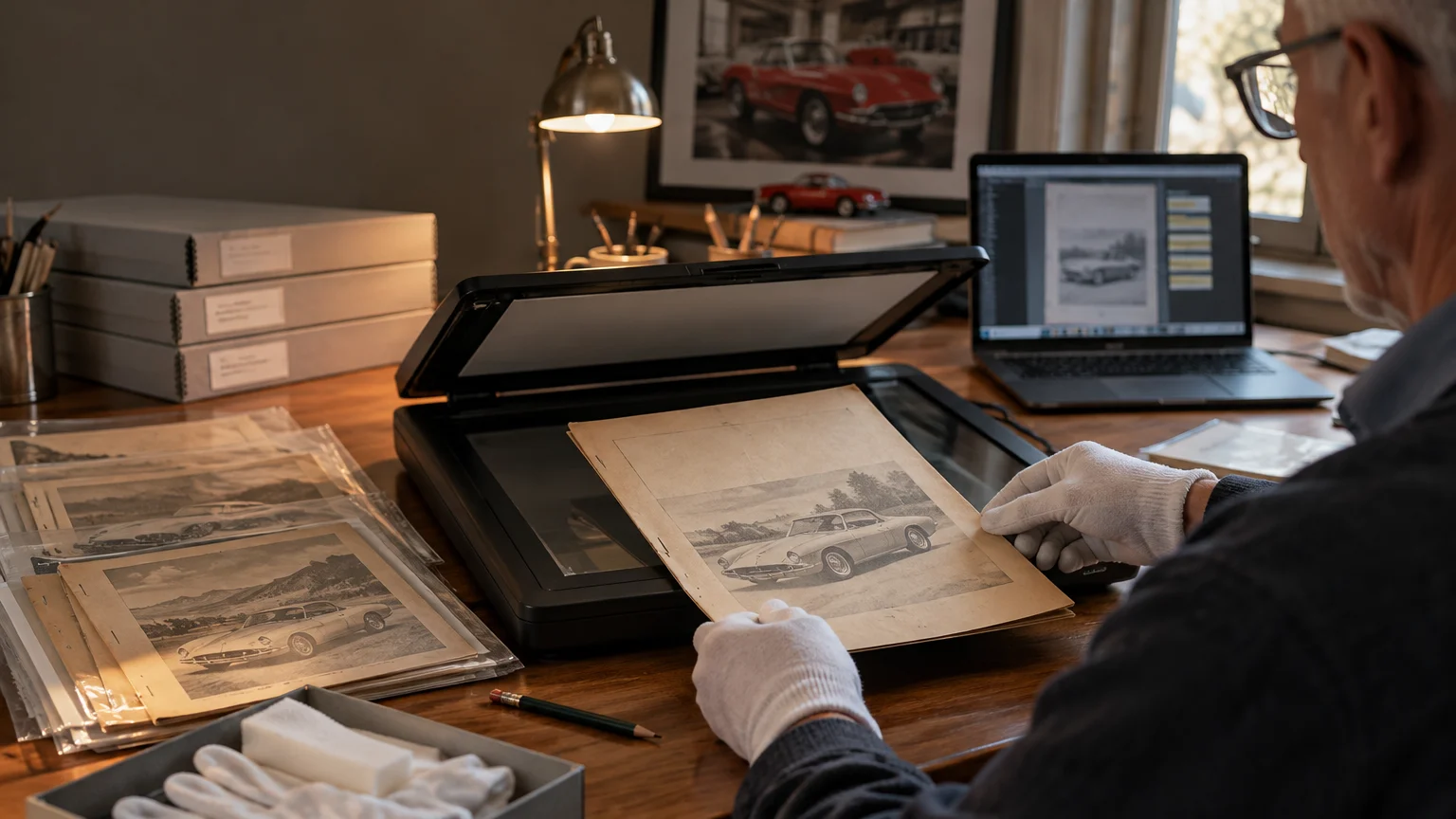
The best way to preserve old Corvette club newsletters is to treat the paper, digital images, searchable PDFs, and catalog information as separate but connected parts of one archive. Keep the originals safely stored, create full-quality master scans, make OCR-enabled PDFs for reading, and record enough information that a future club member can identify every issue.
That may sound elaborate for a box of stapled newsletters rescued from a former officer’s basement. It is not. Club newsletters can preserve show results, officer lists, cruise routes, dealer advertisements, restoration advice, photographs, and the names of members whose work might otherwise disappear from local memory. The Pennsylvania Historical & Museum Commission specifically recognizes newsletters as records capable of documenting organizations and communities. PHMC’s archival records program also identifies scanning, description, preservation supplies, and reduced handling as legitimate archival work.
Start by identifying what survived
Do not begin with the scanner. First arrange the newsletters on a clean, dry surface and make a simple inventory. Record the title, date, volume and issue number when present, page count, physical condition, and the person or collection that supplied the copy. Note missing pages, handwritten additions, inserts, unusual paper sizes, and duplicate issues.
Keep inserts with their original issues, but do not assume every loose sheet belongs where it was found. A registration form tucked into a June newsletter may have come from a later show. Record uncertainty instead of making a confident guess. A short note such as “found inside issue; original placement unconfirmed” preserves useful context without rewriting history.
Before removing staples, unfolding damaged pages, or cleaning anything, inspect the condition. The Library of Congress recommends assessing folds, tears, bindings, joints, housings, and unusual formats before choosing digitization equipment. Its preservation guidance for digitizing library materials is especially useful when a newsletter is fragile, bound, or printed on deteriorating paper.
Preserve four different assets
| Asset | Purpose | What to retain |
|---|---|---|
| Physical original | Preserves the actual historical object | Every complete issue, insert, envelope, and relevant annotation |
| Preservation master | Provides the best digital capture for future use | Unedited, full-quality page images in their original sequence |
| Access PDF | Makes the issue convenient to read and share | A complete PDF with pages oriented correctly and OCR added |
| Catalog record | Explains what the files represent | Date, issue number, source, condition, rights notes, and subject details |
A PDF is not a substitute for the paper newsletter. Digitization preserves intellectual content and reduces routine handling, but it does not preserve the original object, according to the Library of Congress. Paper can reveal print methods, stock, ink, staple placement, handwritten corrections, and other evidence that a compressed access copy may not capture.
Store the paper without trying to improve it
Place newsletters in archival-quality folders and sturdy archival boxes that fit without crushing or bending. Store the boxes in a cool, dry, stable area away from sunlight, plumbing, exterior walls, attics, and damp basement floors. NEDCC offers a practical household benchmark of about 70°F with relative humidity below 55 percent, while the National Archives recommends staying below 75°F and 65 percent relative humidity. Stability matters more than chasing a perfect number with abrupt changes.
Avoid pressure-sensitive tape, self-adhesive albums, rubber bands, and hot lamination. Hot lamination bonds plastic to the document and can accelerate deterioration of the enclosed paper. If an issue is torn, brittle, moldy, or stuck together, isolate it and seek a paper conservator rather than attempting a garage-table repair.
Scan gently and keep an untouched master
A flatbed scanner can work for sound, loose pages that rest naturally on the glass. Do not force a bound volume flat or push a weak newsletter beneath a lid. For fragile, high-value, newsprint, photographic, or bound material, the Library of Congress advises against form-feed scanners and recommends equipment that minimizes heat, light, and physical stress. It also recommends supports or cradles for weak bindings and cautions against putting glass or Plexiglas over originals.
Use consistent filenames that sort naturally. One practical pattern is club name, year, month or issue number, and page number: EACC_1978_06_issue03_p001. If the date is uncertain, mark it as undated or approximate in the catalog rather than embedding a guess as fact.
Use OCR as a finding aid, not as the historical record
Optical character recognition makes a scanned PDF searchable. That turns a stack of images into something members can search for a surname, dealership, autocross, parade, show, or cruise destination. It is one of the biggest practical gains in a newsletter project.
OCR will also make mistakes, especially with faded mimeograph text, narrow columns, decorative headings, typewriter corrections, and photographs with captions. Keep the scanned page visible in the PDF and place the OCR text behind it as a search layer. Do not replace the page image with corrected text and call it the original newsletter.
Spot-check names, dates, vehicle designations, addresses, and headline text. Those are exactly the details researchers are likely to search. If a historic logo or event graphic deserves separate reproduction work, document where it appeared before rebuilding it; the same principle applies when turning an archived design into a new club bumper sticker.
Document rights before publishing the archive
Owning a physical newsletter does not automatically provide permission to republish every photograph, illustration, or member contribution. The U.S. Copyright Office explains that registration of a newsletter as a collective work does not necessarily cover each contribution unless ownership and other requirements are satisfied. Record known authors, photographers, donors, permissions, and contact attempts. A club can preserve a complete internal archive while reviewing what it has authority to place publicly online.
Create backups that can outlast the current volunteer
Keep the preservation masters, access PDFs, and catalog in organized folders with the same issue identifiers. Maintain multiple copies on separate storage devices, with at least one copy in another location. Periodically open a sample of files, confirm that storage devices remain readable, and migrate the collection before old hardware or formats become difficult to use.
A significant Lehigh Valley collection may also deserve an institutional conversation. The Easton Area Public Library’s Henry F. Marx Local History Room preserves regional periodicals, photographs, pamphlets, maps, and newspapers and considers relevant donations. Lafayette College may evaluate community digitization and hosting projects based on regional relevance and staff availability. These are review-based possibilities, not guaranteed acceptance.
The practical next step is simple: inventory one box before scanning one issue. Give every newsletter an identifier, assess its condition, and establish the folder and filename pattern. Once that foundation is sound, the club can digitize at a steady pace without creating a second, electronic box of unidentified history.
References
- Preservation Guidelines for Digitizing Library Materials – Collections Care (Preservation, Library of Congress)
- Help: Daily Newsletters | U.S. Copyright Office
- Apply for a Historical and Archival Records Care (HARC) Grant | Commonwealth of Pennsylvania
- Reformatting – FAQ – About (Preservation, Library of Congress)
- Caring for Private and Family Collections — NEDCC
- How to Preserve Family Archives (papers and photographs) | National Archives
- Preserving paper documents and artworks | naa.gov.au
- Marx Room Home – Easton Area Public Library
- Digitization Policy · Digital Scholarship Services · Lafayette College