Pennsylvania Winter Storage for a Corvette: Moisture, Tires, Battery, and Spring Startup
TLDR
The best Pennsylvania Corvette winter storage plan begins with a clean, completely dry car in a secure garage that does not leak. Check the tires, remove anything that could attract pests, document the car’s condition and mileage, and follow the owner’s manual for your exact model year before making battery, charging, fuel, or parking-brake decisions. During winter, inspect the garage and car rather than assuming both stayed dry. In spring, check for leaks, pest activity, tire-pressure loss, fluid issues, brake concerns, and battery condition before the first drive.
Pennsylvania Corvette winter storage is less about creating a heated showroom and more about controlling water, moisture, pests, and electrical uncertainty. A dry unheated garage can be a sensible seasonal home. A warm garage with a roof leak, wet floor, or easy rodent access is not automatically better.
That distinction matters in the Lehigh Valley. Allentown’s 1991–2020 climate normals show average January temperatures of 38.4°F for the high and 21.8°F for the low, with 3.3 inches of precipitation and 9.8 inches of snow. February averages include 2.77 inches of precipitation and 10.8 inches of snow. The official National Weather Service climate normals for Allentown help explain why owners must plan for wet garage floors and repeated freeze-thaw cycles, not just low temperatures.
Start with the storage space, not the accessories
Before buying a cover, charger, tire cradle, or dehumidifier, inspect the place where the Corvette will sit. Look at the roof after rain, the bottom edges of doors, foundation walls, floor drains, windows, and any plumbing routed through the garage. A small winter leak can go unnoticed when nobody enters the garage for several weeks.
Consider how everyday vehicles use the same space. A family car can carry snow, slush, and road residue into a two-car garage. Meltwater may then travel toward the Corvette depending on the floor’s slope. If possible, park the Corvette where runoff cannot reach it and use containment under the daily driver rather than allowing a wet floor to become normal.
Security and pest access matter too. Close obvious gaps around doors, remove food and bird seed, and clear cardboard or soft nesting material from the immediate storage area. Inspect safely rather than placing unverified chemicals or traps near children, pets, wiring, paint, or upholstery.
| Storage location | Reasonable approach | Condition requiring attention |
|---|---|---|
| Heated and dry garage | Use the normal preparation checklist and monitor conditions periodically. | Heat does not correct roof leaks, plumbing leaks, or runoff from another vehicle. |
| Unheated but dry garage | Usually workable when the car is dry, secure, and prepared according to its manual. | Watch for condensation, water intrusion, pests, and tire-pressure changes. |
| Damp or leak-prone garage | Repair or isolate the moisture source before treating the space as suitable storage. | Do not cover or abandon a damp car in a damp building. |
| Garage without electrical power | Use the exact manual to select an approved battery-storage procedure. | Do not improvise extension-cord or charging arrangements. |
| Temporary outdoor location | Seek secure indoor storage if practical and use vehicle-specific guidance in the meantime. | Weather exposure, drainage, wind, security, and cover movement all become larger concerns. |
A practical Pennsylvania Corvette winter storage sequence
1. Choose a dry final drive
If weather and road conditions permit, make the last drive one that leaves enough time to clean and dry the car before storage. Avoid turning a final autumn outing into a run through fresh road treatment, slush, or standing water. The goal is to put the car away clean and dry, not merely warm.
2. Wash carefully and dry the hidden areas
Clean the body, glass, wheels, wheel openings, and other accessible areas where dirt and moisture collect. Dry door jambs, hatch or trunk channels, mirror housings, fuel-door recesses, and weatherstrip contact areas. Do not place a cover over a wet car. A cover can protect a clean finish from garage dust, but it is not a cure for existing moisture or an unsuitable building.
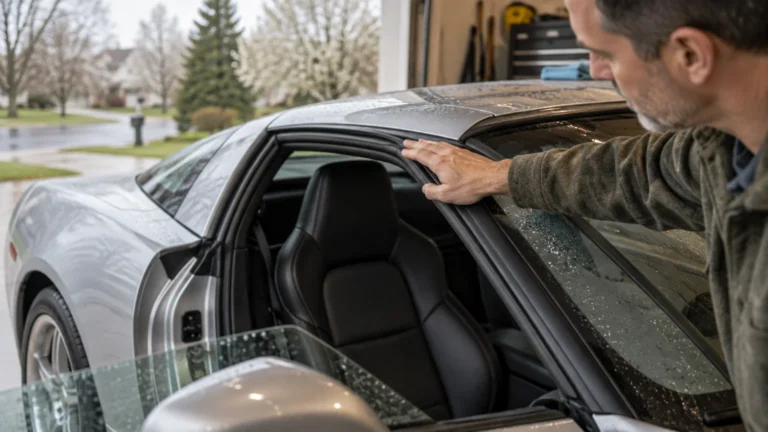
If you find damp carpet or signs of water entry, investigate before storage. Roof, door, hatch, and window seals deserve attention, particularly on an older car. Our Corvette weatherstripping inspection guide explains how to approach visual checks and controlled water testing.
3. Clean the cabin and storage compartments
Remove snacks, wrappers, paper bags, cleaning towels, and unnecessary cardboard. Empty removable containers and inspect under seats and in rear storage areas. This is also a good time to confirm that windows, doors, the hatch, and any removable roof panel are properly secured according to the vehicle’s instructions.
4. Record the car’s condition
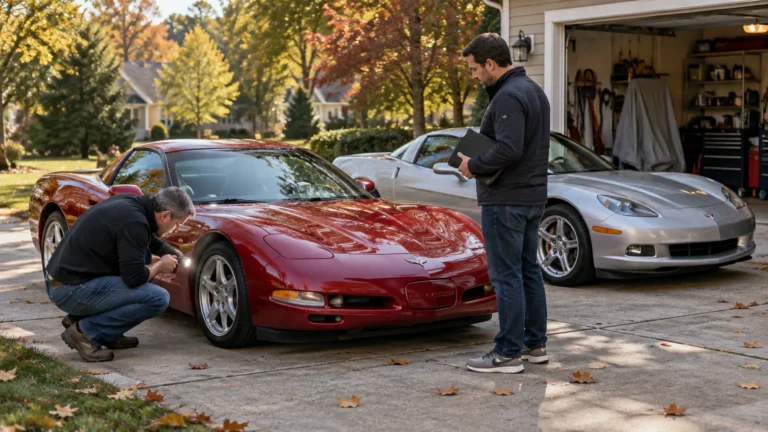
Photograph all four sides, the wheels, the instrument display, and the garage position. Record the date, mileage, tire pressures, visible fluid levels that the manual directs the owner to check, and any existing warning messages. Documentation turns spring inspection into a comparison instead of a memory test.
Keep the record in a maintenance binder or a digital note. For a shared club garage-day project, custom storage-date stickers and bin labels can help identify records, parts boxes, or dedicated supplies. Put labels on the organizer, not on painted, leather, or delicate vehicle surfaces.
5. Inspect the tires without inventing a pressure target
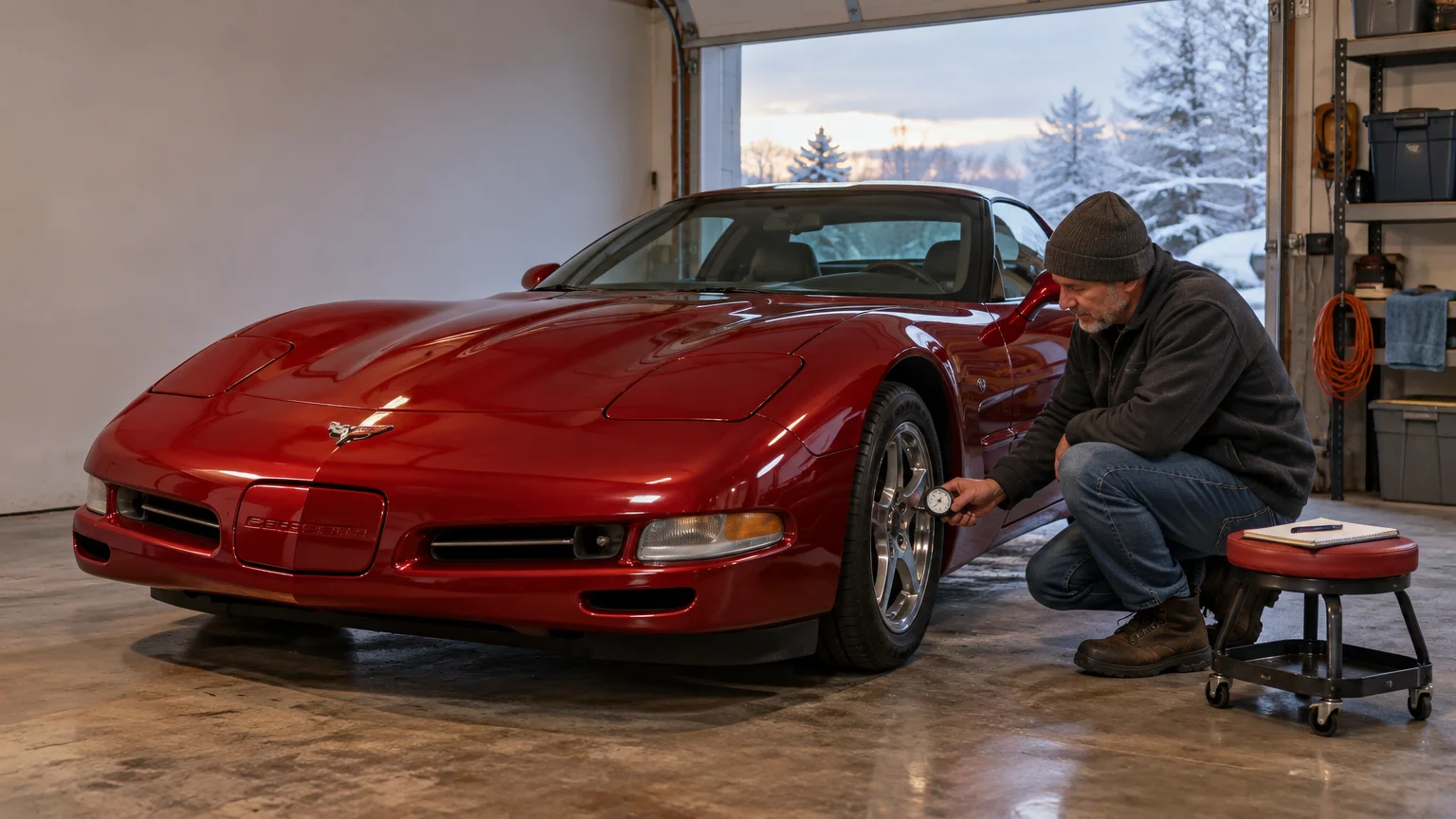
Check every tire for visible damage, embedded objects, unusual wear, and low pressure. Set pressures using the vehicle’s tire-information label and owner’s manual rather than a number copied from another Corvette. Different generations, trims, wheel packages, and tire constructions can require different treatment.
Do not assume that maximum sidewall pressure is a storage recommendation. Likewise, do not lift the car or place it on stands merely because another owner does. Supporting and lifting procedures can be model-specific, and an incorrect lift point can cause expensive damage.
6. Let the exact owner’s manual decide battery care
Chevrolet maintains a manuals-and-guides lookup where owners can select the applicable model year, make, and model. Use that document as the controlling source for battery disconnection, charging, storage mode, access procedures, and related warnings.
Before connecting any maintainer, confirm that it is appropriate for the battery chemistry and vehicle instructions. Also verify that the outlet, cord routing, and charger location are safe. If the garage has no dependable power, do not build a makeshift charging arrangement. Follow the vehicle’s approved alternative procedure or consult a qualified Corvette service professional.
7. Handle fuel and other model-specific items by the book
Generic storage lists often prescribe a particular fuel level, additive, parking-brake position, or periodic starting routine. Those recommendations should not override the manual for the actual car. Check the storage section and follow any product directions that the manual authorizes. If the instructions are unclear, obtain model-specific guidance before parking the car for several months.
C8, Z06, and E-Ray owners need model-specific instructions
A routine inherited from a C3, C5, or C6 should not automatically be applied to every newer Corvette. Electrical architecture, battery chemistry, component access, and powertrain systems have changed across generations and variants.
The 2025 Corvette Owner’s Manual contains a vehicle-storage section. It also directs Z06 and E-Ray owners to inspect the engine air cleaner and remove leaves, dirt, and debris before storing the vehicle for any length of time. That is a good example of a current, variant-specific instruction that a generic checklist might miss.
E-Ray owners should be especially cautious about generalized battery advice because the model has electrical considerations beyond those of a conventional Corvette. Locate the manual for the exact model year and follow its storage procedures rather than adapting a forum post or an older-car routine.
Worked example: an unheated Lehigh Valley garage
Consider a Corvette stored from November through March in a dry, unheated two-car garage. The owner first checks the roof and door seals during autumn rain, then confirms that water from the daily driver flows away from the Corvette’s parking position. Food, cardboard, and loose cleaning cloths are removed from the storage area.
On a dry day, the owner washes and thoroughly dries the Corvette, cleans the interior, checks the tires against the car’s label, photographs its condition, and records the mileage. The exact owner’s manual supplies the battery and vehicle-storage procedure. A clean, breathable cover is fitted only after the car and floor are dry.
Once a month, or after severe weather, the owner visually checks the garage. This is not a maintenance schedule for every Corvette; it is a practical building-inspection routine. The owner looks for roof or wall leaks, standing water, disturbed materials, pest evidence, visible fluid beneath the car, tire changes, and charger warnings if an approved charger is fitted.
What the owner does not do is start the engine for a few minutes simply to hear it run. Short periodic starting is not treated as a universal requirement. If the applicable manual specifies an action during long-term storage, follow it. Otherwise, leave the car prepared and undisturbed rather than improvising a ritual.
Spring startup is an inspection, not just a key turn
The first bright Pennsylvania weekend can make any owner eager to open the garage door. Give the car a deliberate inspection before joining traffic.
- Look under and around the car for fluid, water, pest debris, or disturbed wiring.
- Inspect the engine compartment and accessible intake or filter areas as directed by the manual.
- Check tire condition and pressure against the vehicle label.
- Check applicable fluid levels using the procedures and specifications in the manual.
- Confirm that the battery procedure has been completed correctly and that no warning remains on an approved charging device.
- Inspect the brakes visually where possible, then verify normal pedal feel and operation before entering public roads.
- Check exterior lights, wipers, glass, mirrors, and required safety equipment.
- Listen and watch for warnings during startup; do not dismiss an unfamiliar message simply because the car was running normally in autumn.
Make the first drive short and close to home. Use gentle inputs while confirming steering, braking, tire behavior, instruments, and normal operating indications. If a warning, leak, vibration, abnormal noise, or brake problem appears, stop and resolve it rather than turning the outing into a longer spring cruise. For a broader pre-drive review, use our Corvette road trip checklist before the season’s first major event.
Keep the off-season connected to the hobby
Winter has long been part of local Corvette life rather than a complete pause. An archived April 2013 issue of The Blue & Gold described the Easton Area Corvette Club, established in 1968, holding monthly winter meetings from November through February. That old rhythm still makes sense: winter is when records get organized, maintenance is planned, and the next season begins to take shape.
Use a simple storage sheet with the date, mileage, tire pressures, battery procedure, noted defects, and planned spring work. Place a copy in the garage and another with the vehicle records. Before changing any electrical, fuel, lifting, or battery procedure, check the Chevrolet manual for the exact year and model.
The practical next step
Walk through the garage after the next rain or snowmelt. Find where water enters, where the daily driver drains, whether pests have access, and whether dependable power is available. Then retrieve the correct owner’s manual and build the storage plan around that car—not around a generic Corvette checklist. A dry garage, documented condition, correct tire pressure, manual-approved battery care, and a patient spring inspection provide a sensible baseline for a Pennsylvania winter.