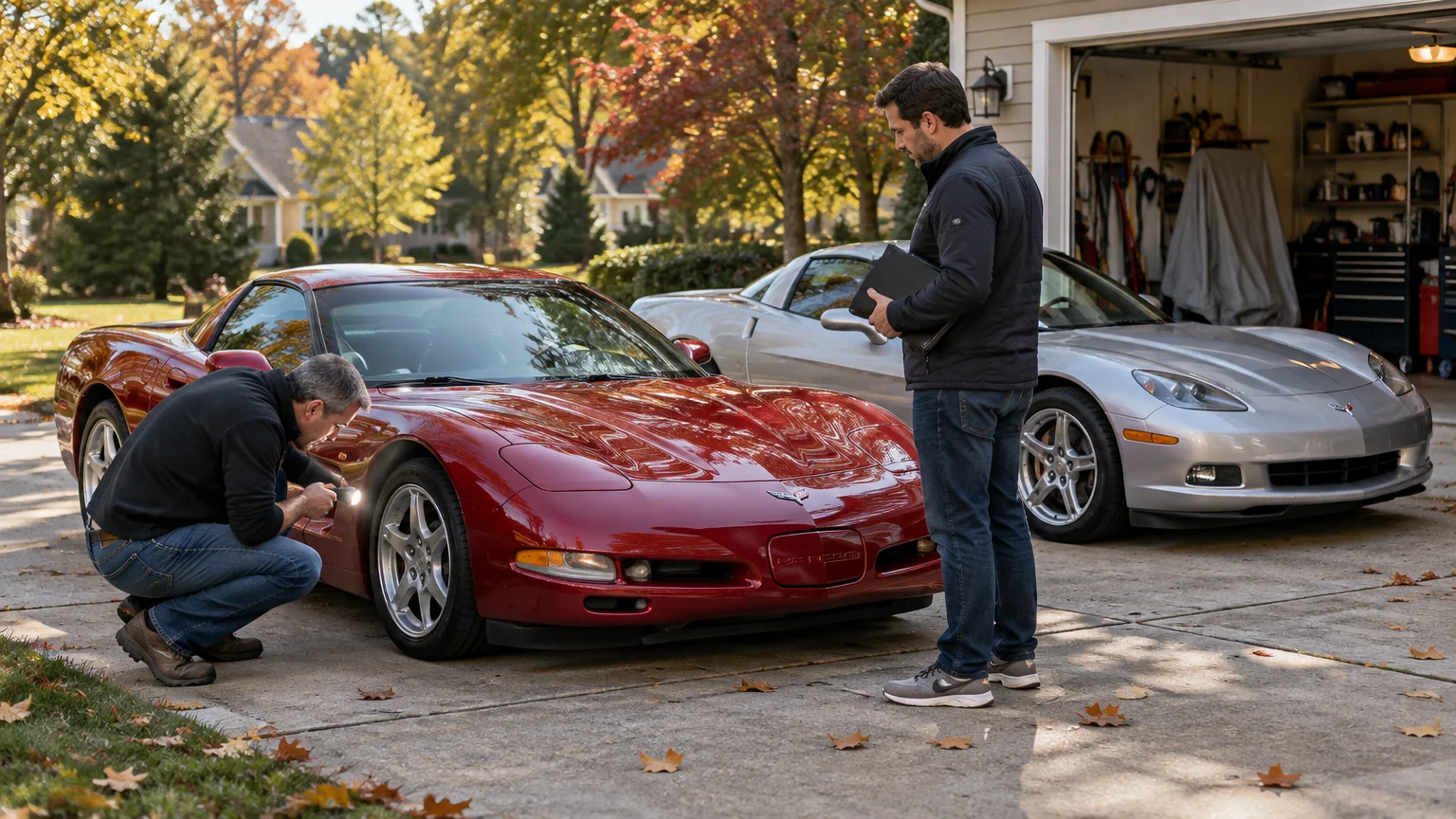
C5 and C6 Corvettes as Affordable Entry Points to the Hobby
TLDR
The safest approach to C5 C6 affordable Corvette ownership is to buy the best-documented, best-inspected car you can comfortably support after the sale. A clean base C5 or C6 with transparent maintenance history will usually make a more sensible first Corvette than the least expensive listing or a heavily modified performance model. Keep part of your budget available for tires, fluids, insurance, registration, storage, wear items, and unexpected repairs.
Both generations can open the door to Corvette ownership without making the experience feel second-rate. The C5 offers unmistakably late-1990s character, pop-up headlights, and the engineering foundation of the modern Corvette. The C6 feels newer and more compact visually, with exposed headlights and a more contemporary cabin. Condition matters more than choosing a generation by reputation alone.
C5 versus C6 at a glance
The C5 debuted for the 1997 model year. The National Corvette Museum highlights its hydroformed side-rail backbone chassis as an important generational development. Readers interested in that engineering transition can explore the museum’s C5 wire-frame model and chassis overview. The C6 followed for 2005, bringing exposed headlights back to the Corvette for the first time since 1962.
| Consideration | C5 Corvette | C6 Corvette |
|---|---|---|
| Model years | 1997–2004 | 2005–2013 |
| Visual character | Pop-up headlights and rounded late-1990s styling | Exposed headlights and a tighter, more contemporary shape |
| First-car shopping logic | Prioritize preservation, service history, seals, tires, and evidence of careful storage | Prioritize service history, tires, electronics, controls, and evidence of careful storage |
| Sensible starting point | A stock or lightly modified base coupe or convertible with records | A stock or lightly modified base coupe or convertible with records |
| Performance choices | C5 Z06 | C6 Z06 and C6 Grand Sport |
| Best deciding factor | The condition of the individual car | The condition of the individual car |
The table is not a verdict that one generation is universally cheaper or more reliable. Asking prices change with mileage, transmission, body style, options, color, location, season, and seller expectations. A proper comparison begins only after examining actual cars and determining what each one will need during its first year with you.
The real test of C5 C6 affordable Corvette ownership
A Corvette is affordable to own when the purchase leaves enough room to operate, maintain, insure, and enjoy it. A low advertised price can conceal deferred maintenance. Conversely, a higher-priced car with useful records, sound tires, recent routine service, and fewer unanswered questions may produce the more manageable first year.
Build the budget in two parts. The first part purchases the car. The second remains untouched until you understand what the car needs. That reserve should account for immediate maintenance, inspection findings, tires, fluids, filters, brakes, battery needs, registration, insurance, storage arrangements, and unplanned repairs. The exact reserve depends on the vehicle and your ability to perform work yourself, so a universal dollar figure would be misleading.
GM’s 2006 Corvette owner manual notes that maintenance needs vary with vehicle use and emphasizes inspections, fluids, and scheduled work as part of keeping the car in proper operating condition. That principle applies across both generations: a car driven occasionally still ages, and a low odometer reading does not stop rubber, fluids, batteries, seals, or tires from deteriorating.
Service records can matter more than a tempting odometer
Mileage is useful, but it is only one line in the story. A moderately driven Corvette with organized invoices may be easier to evaluate than a seldom-used car with no explanation of where it sat, how it was stored, or when its age-sensitive components were serviced.
Look for dated invoices rather than a seller’s general assurance that everything is current. Match the paperwork to the VIN and mileage where possible. Records should help establish patterns: regular maintenance, recurring complaints, accident repairs, tire replacement, brake work, fluid service, and modification history.
Storage conditions deserve attention in eastern Pennsylvania. Ask whether the car spent winters outside, sat on damp flooring, encountered road salt, or developed water intrusion. Inspect the carpet and storage areas for moisture or odors, and examine the seals carefully. Our C5 and C6 weatherstrip inspection guide explains where to look before spring rain exposes a neglected seal.
A practical C5 or C6 pre-purchase checklist
- Record the VIN and compare it with the title, service invoices, vehicle-history material, and labels on the car.
- Run the VIN through the official NHTSA recall lookup. Do not assume that a model year’s inclusion in a campaign proves that one particular car has an open recall.
- Review maintenance invoices before the test drive so you know which claims and recent repairs should be verified.
- Ask the seller not to warm the car before you arrive. Observe the cold start, warning lights, gauges, exhaust, idle, and any unusual sounds.
- Test the car at neighborhood and highway speeds when conditions allow. Evaluate steering, braking, shifting, ride, vibration, climate controls, windows, locks, seats, lights, and dashboard functions.
- Read each tire’s date code and inspect tread depth, cracking, sidewall damage, repairs, and uneven wear. Attractive tread alone does not establish that an older tire is suitable for continued use.
- Inspect underneath for leaks, corrosion, damaged panels, careless lifting, fresh coatings that obscure surfaces, and signs of previous impact repair.
- Check the cabin, hatch or trunk, and low storage areas for moisture, staining, odors, or evidence of water entry.
- Document every modification. Ask who installed it, whether tuning was involved, which original parts remain, and whether supporting invoices or instructions are available.
- Arrange an independent pre-purchase inspection with a shop familiar with the generation. Give the technician enough time to inspect the car on a lift and scan its systems where appropriate.
NHTSA says owners and shoppers can use a vehicle’s 17-character VIN to identify unrepaired recalls. Safety recalls do not expire, and recall repairs are performed without charge. GM’s Takata material includes specified C5- and C6-era Corvette applications, but that does not tell you the status of an individual car. Use the official NHTSA recall resources and search the exact VIN rather than relying on a seller’s memory or a model-year list.
Base Corvette or performance model?
For a first Corvette, a base coupe or convertible deserves serious attention. It provides the shape, V8 character, community access, and touring appeal that bring most owners into the hobby. Buying the calmer badge can also leave more of the total budget available for maintenance, travel, and learning the car.
That does not make the special models poor choices. It means they require a separate calculation. The C5 Z06 was offered from 2001 through 2004 with a six-speed manual and LS6 5.7-liter V8. GM lists output at 385 horsepower for 2001 and 405 horsepower for 2002 through 2004. If that specification is the reason you want a C5, shop deliberately rather than treating the Z06 as merely another inexpensive used Corvette.
The C6 Z06, offered from 2006 through 2013, used a 505-horsepower 7.0-liter LS7 and a six-speed manual. Its performance identity and model-specific hardware warrant an inspection and ownership plan tailored to that car. Badge prestige should not substitute for records, condition, or professional evaluation.
The 2010–2013 C6 Grand Sport occupies another distinct position. Chevrolet describes it as combining the LS3 base engine with wide bodywork, larger brakes, and hardware related to the Z06 and ZR1. Manual-transmission cars also received unique ratios and dry-sump oiling. Those differences are meaningful, so compare a Grand Sport with other Grand Sports rather than assuming it carries the same purchasing considerations as every base C6.
Choose the transmission around real use
A manual may suit the buyer who wants maximum involvement on weekend drives. An automatic may make more sense in traffic, on relaxed cruises, or in a household where more than one person will drive the car. Neither choice is inherently more authentic. The right transmission is the one that encourages you to use the Corvette rather than leave it in the garage.
Think about the roads and events that will fill your calendar. A Lehigh Valley owner might combine local back roads, interstate travel, summer shows, and occasional longer trips. Before the first substantial outing, work through a Corvette road-trip checklist instead of assuming a successful short test drive proves the car is ready for several hundred miles.
Stock, lightly modified, or extensively changed?
For a first purchase, stock or lightly modified cars are generally easier to understand. Factory documentation and ordinary service records give an inspector a clearer baseline. Familiar changes such as wheels or an exhaust are not automatically disqualifying, but their installation quality and supporting documentation still matter.
Approach extensive modifications as a package rather than a list of free upgrades. Engine changes, forced induction, suspension alterations, nonstandard wheel fitments, tuning, wiring work, and removed emissions equipment can affect inspection requirements, drivability, repair choices, and the number of shops willing to diagnose the car. Buy that sort of Corvette only when you understand both the work and the purpose behind it.
A seller should be able to explain what was changed, who did the work, and whether original components are included. If the answers are vague, price alone should not persuade you to inherit someone else’s unfinished project.
The Lehigh Valley connection
C5 and C6 cars now occupy a pleasant middle ground in Corvette culture. They are modern enough for regular regional drives yet old enough to trigger memories of dealership windows, club newsletters, and show fields from a different era. Either generation can participate comfortably in today’s gatherings without needing to be a concours restoration.
The local heritage reaches back well before either car. An archived April 2013 issue of The Blue & Gold identified the Easton Area Corvette Club as having been established in 1968. A 2020 Allentown Area Corvette Club newsletter later referred to the Easton club’s disbanding. Those dated references are historical rather than evidence of a current club program, but they remind us that the regional Corvette story survives through cars, photographs, newsletters, and the owners who continue to gather.
Once your new-to-you Corvette is mechanically ready, preparing it for a community show can be as simple as cleaning it carefully and presenting an honest, well-kept driver. The Corvette show-preparation checklist covers the details that are easy to miss when excitement takes over.
A sensible next step
Start with a shortlist of stock or lightly modified base C5s and C6s with transparent records. Decide on coupe or convertible, manual or automatic, and your must-have features before looking at badges. For every candidate, inspect the tires and underside, check the exact VIN for recalls, review invoices, and arrange a Corvette-aware pre-purchase inspection before negotiating.
If a Z06 or Grand Sport remains the car you truly want, expand the inspection and reserve to reflect its distinct equipment rather than stretching the entire budget simply to acquire the badge. The best first Corvette is not necessarily the newest, fastest, or least expensive. It is the one whose history you can understand, whose needs you can support, and whose keys make you want to take the long way home.
References
- C5 Corvette Wire-frame Model – National Corvette Museum
- Museum Collection | National Corvette Museum Member Portal
- 2006 Chevrolet Corvette Owner Manual
- Resources Related to Investigations and Recalls | NHTSA
- Check for Recalls: Vehicle, Car Seat, Tire, Equipment | NHTSA
- The Takata Airbag Safety Recall
- 2023 Chevrolet Corvette Z06 Elevates the American Supercar
- Chevrolet introduces 2027 Corvette Grand Sport at Sebring
- to Open – the EASTON AREA CORVETTE CLUB
- Allentown Area Corvette Club, Inc. A Proud