
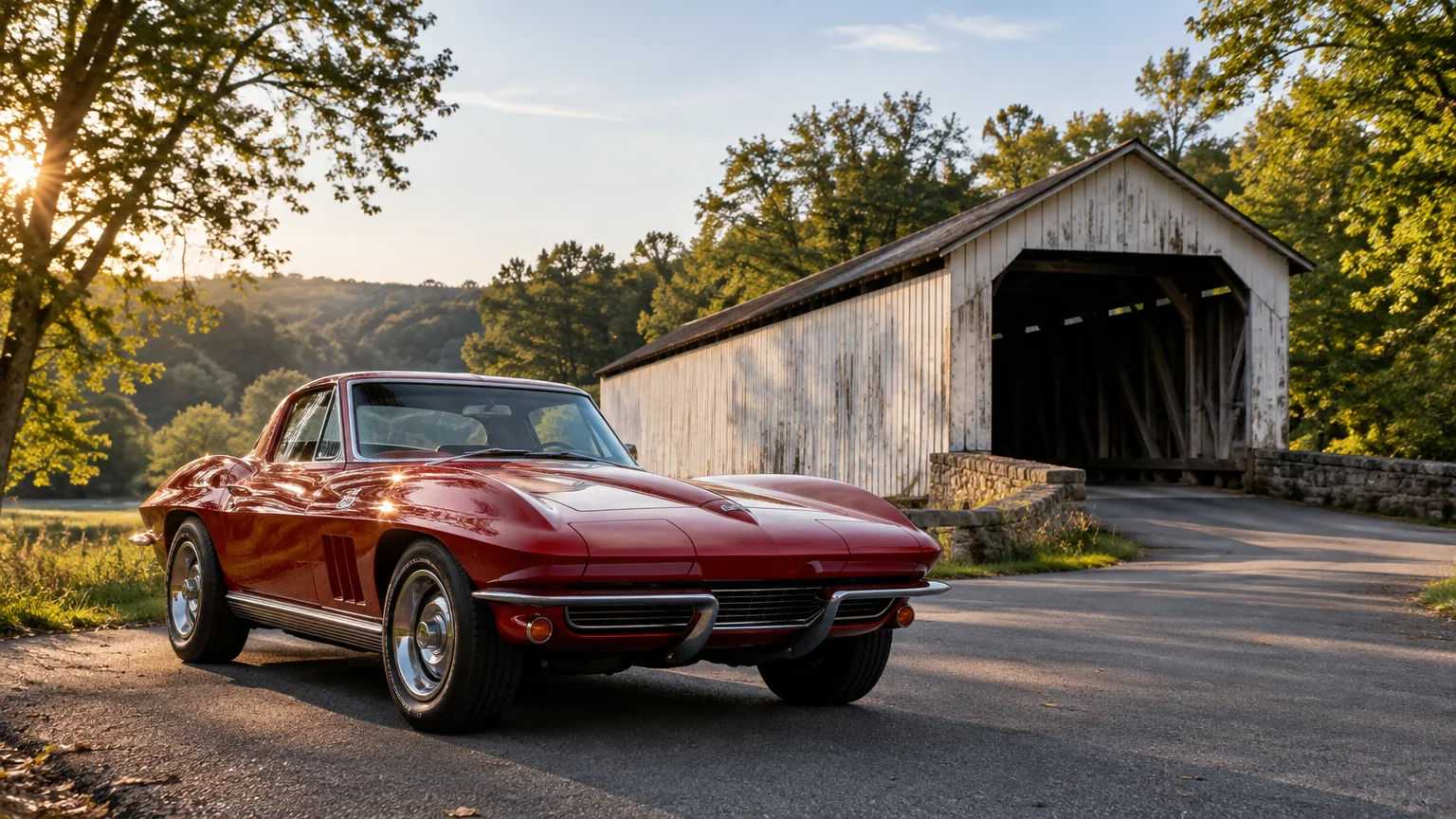
How to Build a Local Corvette Photo Route
A strong Lehigh Valley Corvette photo route needs variety more than mileage. Choose one waterfront setting, one industrial backdrop, one covered bridge or country road, and one quiet natural setting. That combination can tell a local story without turning the day into an exhausting scavenger hunt.
A practical route can begin at Scott Park in Easton, continue through a rural or covered-bridge area, and finish around Bethlehem’s former steel complex. Jacobsburg can replace the bridge segment when trees, fields and a less architectural background better suit the car. Treat these as route modules rather than mandatory stops, and confirm access before leaving home.
Build the route around four different visual moods
Corvettes are visually assertive cars. If every stop has the same trees, gray pavement and midday light, the finished album can feel surprisingly repetitive. Assign each location a job before plotting the drive.
| Route module | What it contributes | Best use |
|---|---|---|
| Easton waterfront | River, bridges and regional transportation history | Opening portraits and wide environmental views |
| Covered-bridge country | Wood construction, stonework and winding Pennsylvania roads | Three-quarter views and cruise photographs |
| Jacobsburg area | Fields, forest edges and quieter natural scenery | Paint-focused portraits with a simple background |
| Bethlehem industrial district | Steel structures, masonry and strong geometric lines | Closing images, detail shots and club-history atmosphere |
This framework works for one Corvette or a small group. For a larger club cruise, reduce the number of stops. Moving ten cars into position, maintaining sight lines and returning every car to traffic safely takes much longer than photographing a single vehicle.
Start with the Easton waterfront
Scott Park gives the route an unmistakable Easton beginning. The city identifies it as a waterfront park at the confluence of the Delaware and Lehigh Rivers, south of the Northampton Street Bridge. Views include the Lehigh Dam and several historic transportation bridges, and the city notes that patrons can use on-street parking. Easton’s waterfront information is worth checking before the trip for current access details.
Use the bridges and water as background rather than trying to include everything in one frame. A low front three-quarter view can place the Corvette against a bridge span, while a longer view can show more of the river setting. Watch for signs, lamp posts and tree trunks appearing to grow from the roofline.
Early light is usually easier on polished paint than harsh midday sun. It also gives the photographer more time to work carefully before the waterfront becomes busier. Keep the car in a legal space, and do not assume that a boat-launch area or open patch of pavement is available for vehicle staging.
Choose one covered bridge instead of chasing all seven
Discover Lehigh Valley’s Historic Covered Bridge Tour is approximately 50 miles, signposted and intended to take several hours with photo stops. It includes seven surviving covered bridges, five of which remain open to vehicle traffic. The official Historic Covered Bridge Tour is the useful starting point for choosing a segment.
For a dedicated driving day, the full tour has obvious appeal. For a Corvette photo route, however, one carefully selected bridge will usually produce better results than rushing through the entire loop. Wehr’s Bridge is a two-lane bridge dating to 1841 beside Covered Bridge Park. Geiger’s Bridge, dated to 1860, has a distinctive stepped portal. Kreidersville Bridge dates to 1839 and is pedestrian-only, so it should be treated as historical scenery rather than a Corvette crossing.
A traffic-bearing covered bridge is still a public crossing. Drive through normally, then use a lawful parking area or established photo stop. Never pause in a travel lane, arrange cars across the entrance or send a photographer into traffic. The tour’s invitation to make photo stops does not grant control of a road or bridge.
For a rolling photograph, the safer choice is a passenger photographing from inside another legally moving vehicle while everyone follows traffic laws. Better yet, use a stationary camera position from a safe public area and photograph each Corvette as it passes normally. Do not ask drivers to bunch tightly for the camera.
Use Jacobsburg for a quieter natural background
Jacobsburg Environmental Education Center offers forests, fields and creek scenery across 1,168 acres. It also contains the Jacobsburg National Historic District, which is associated with local Henry Rifle manufacturing. The Pennsylvania Department of Conservation and Natural Resources says the center is open daily from sunrise to sunset, with day-use areas closing at dusk. DCNR’s Jacobsburg visitor page should be checked for current conditions.
This is the route’s quieter option, especially when an elaborate covered-bridge loop would make the day too long. Look for a lawful paved position where the car can remain entirely within an approved vehicle area. Forest edges make strong backgrounds because they simplify reflections and let the Corvette’s profile carry the image.
Permission matters here. DCNR requires prior written authorization for activities or business conducted in state parks and forests, explicitly including professional photography. Its special-activity process asks for requests at least 90 days in advance. A casual owner taking a few personal photographs is not the same project as a professional, commercial or organized club production, but the property operator should decide which rules apply—not the photographer. Review DCNR’s special-activity requirements and contact the site when the scope is uncertain.
Finish with Bethlehem’s industrial history
Bethlehem provides the visual counterpoint to rivers, trees and covered bridges. Historic Bethlehem dates the city’s founding as a Moravian community to 1741, while the later steelmaking landscape gives a Corvette portrait heavier industrial lines and textures. Visitors may independently walk Historic Downtown Bethlehem, the Colonial Industrial Quarter, Burnside Plantation grounds and the Hoover-Mason Trestle.
The Hoover-Mason Trestle at SteelStacks opened in 2015 and runs along the former Bethlehem Steel blast furnaces. ArtsQuest lists entrances at the Bethlehem Visitor Center and near the Gas Blowing Engine House from the Wind Creek parking side. Regular listed hours are 10 a.m. to 8 p.m. Sunday through Wednesday and 10 a.m. to 9 p.m. Thursday through Saturday, although weather and special events can cause closures.
The trestle is a walking location, not a place to stage a Corvette. Use it to study the furnaces, capture contextual images and identify legal ground-level viewpoints. Keep the car in an authorized parking or roadway setting and confirm restrictions for any organized shoot. A telephoto composition can visually bring the industrial structures closer without placing the vehicle somewhere it does not belong.
Scout the route before bringing the polished car
A phone-based scouting trip can prevent most photo-day disappointments. Check pavement transitions, overhead clearance, posted parking rules, construction, event closures and the direction of the sun. A location may look perfect online yet offer no safe place to stand ten feet from the car.
- Save one primary and one backup position at every stop.
- Record the safest entrance and exit, especially for low-clearance Corvettes.
- Check whether restrooms, fuel and food are available along the route.
- Note where a group can regroup without obstructing local traffic.
- Confirm park hours, special events and property-specific photography rules.
- Build extra time into the schedule for moving and aligning multiple cars.
Before a longer loop, use a proper Corvette road trip checklist rather than treating the outing as a quick drive across town. Tire condition, fluid levels, battery health and a basic tool kit matter even when the camera is the day’s main attraction. Clubs should also plan fuel stops around the least-flexible car in the group; the site’s guide to building fuel stops into a club route covers that part of the logistics.
Prepare the Corvette for reflective paint and close photographs
Photo preparation is not the same as show preparation. Concentrate on the surfaces the camera will actually see: front fascia, windshield, wheels, tires, mirrors and the upper body panels. Carry clean microfiber towels and an appropriate quick-detail product for dust or fingerprints, but avoid doing a full cleaning beside a river or in a busy public parking area.
Remove loose items from the cabin and decide whether the windows will be up or down throughout the set. Turn the front wheels slightly toward the camera for a three-quarter portrait, but keep them straight for a clean side profile. Check headlamps, daytime running lamps and parking lamps before the trip so lighting choices look deliberate rather than accidental.
Dark paint will mirror bright pavement, signs and the photographer. Light paint can lose body contours under flat skies. Move the car a few feet or change the camera height before reaching for complicated editing. A circular polarizing filter can reduce some glare, but its effect varies across curved panels, so rotate it carefully and compare frames.
Give the finished photographs a historical job
A local Corvette photo route can produce more than social-media images. Record the date, location, car year, owner’s preferred name and event or cruise title while those details are fresh. Preserve one wide scene at each stop, even if the tight portrait is more dramatic. Years later, the wide photograph will show how the waterfront, bridge approach or industrial district looked at that moment.
For a club group, assign one person to maintain a simple image log. Photograph any temporary event sign separately, and save the original files before cropping or adding graphics. Those small habits turn an enjoyable driving day into useful regional history.
The route does not need every famous Lehigh Valley landmark. One Easton river view, one Pennsylvania bridge or natural setting, and one Bethlehem industrial backdrop will give the album a beginning, middle and end. Scout first, keep every Corvette on lawful vehicle surfaces, and leave enough time to enjoy the drive. The local landscape will do the rest.
Frequently Asked Questions
What is the best basic Lehigh Valley Corvette photo route?
Start near the Easton waterfront, choose one covered bridge or Jacobsburg-area natural setting, and finish near Bethlehem’s former steel complex. The three settings give the album a clear beginning, middle and end.
Should a Corvette photo day include all seven covered bridges?
Usually not. The official tour is approximately 50 miles and takes several hours with photo stops, so one carefully chosen bridge leaves more time for safe positioning and better photographs.
Can Corvettes stop inside a covered bridge for photographs?
No. Traffic-bearing bridges are functioning public crossings. Drive through normally and photograph from a lawful, safe public position without blocking the entrance or travel lane.
Does photography at Jacobsburg require permission?
DCNR requires prior written authorization for professional photography and certain organized activities on state land, with complex-activity requests submitted at least 90 days ahead. Contact the property operator when the scope of a club shoot is uncertain.
Can a Corvette be staged on the Hoover-Mason Trestle?
No. The trestle is a walking location along the former Bethlehem Steel blast furnaces. Use authorized ground-level parking or roadway settings and compose the industrial structures into the background.
What details should be saved with the finished photographs?
Record the date, location, Corvette year, owner’s preferred name and event or cruise title. Keep the original files and at least one wide view from every stop to preserve the changing regional setting.
References
- Easton Waterfront | Easton, PA
- Lehigh Valley’s Historic Covered Bridge Tour | Discover Lehigh Valley
- Jacobsburg Environmental Education Center | Department of Conservation and Natural Resources| Commonwealth of Pennsylvania
- Request to Hold Group Events and Special Activities in State Parks and Forests | Commonwealth of Pennsylvania
- Visit Our UNESCO World Heritage Sites | Historic Bethlehem
- Other Locations – ArtsQuest