What Is a Vinyl Decal? Choosing a Format for Club Reproductions
TLDR
A vinyl decal is an adhesive-backed graphic made for installation on a compatible surface such as glass, painted metal, or certain plastics. It may be cut from solid-color film or printed in multiple colors, and some printed decals add a protective laminate. For a Corvette or club-history project, choose the format only after considering the surface, curves, desired appearance, expected duration, removal plan, and condition of the underlying finish.
If you are asking what is a vinyl decal because you want to recreate a club window graphic, add show lettering, or preserve an old event design, the practical answer matters more than the label. “Sticker” and “decal” overlap in everyday use. What deserves closer attention is the complete graphic system: film, adhesive, printing or cutting method, optional laminate, installation technique, and eventual removal.
What a vinyl decal is made of
A typical vinyl decal begins with a flexible vinyl film and a pressure-sensitive adhesive. Before installation, a coated release liner protects the adhesive. A printed decal may also have a clear laminate over the ink to provide the finish or protection specified for that product.
Many cut-vinyl graphics add another temporary layer called application tape or premask. It holds separate letters, numbers, and design elements in position while the graphic moves from its liner to the final surface. After the vinyl bonds to the surface, the installer removes the application tape. 3M describes this tape as a way to maintain registration, aid transfer, and protect a graphic during installation.
That construction explains why a cleanly installed cut-vinyl club name may appear painted on. There may be no clear background around the letters because the excess film was removed before transfer. A printed decal, by contrast, commonly transfers as one complete piece with the artwork printed onto it.
Is a vinyl decal the same as a sticker?
There is no universal everyday rule separating a vinyl decal from a vinyl sticker. Vendors and owners use the terms differently. Rather than relying on the name, ask how the graphic is made, where it can be installed, whether it has a background, and how it should be removed.
| Format | Typical construction | Useful applications | Main question to ask |
|---|---|---|---|
| Cut-vinyl decal | Solid-color film cut into letters or shapes; often transferred with application tape | Club lettering, simple logos, numbers and stripes | Will every small element transfer and remain secure? |
| Printed vinyl decal | Artwork printed on vinyl; laminate may be available | Multicolor event graphics, illustrations and detailed reproductions | Are the ink, laminate and adhesive suited to the intended surface and exposure? |
| Ordinary sticker or label | May use vinyl, paper or another face material | Short-term labels, packets and indoor identification | Is it actually rated for the planned automotive or outdoor use? |
| Emblem or badge | A separate rigid or dimensional part attached mechanically or with adhesive | Factory-style identification and dimensional display pieces | How is its weight supported, and can it be removed without harming the finish? |
| Vehicle wrap | Larger sections of conformable graphic film | Broad color changes, advertising or large decorative treatments | Is the film suitable for the curves, recesses and installation scope? |
A rigid emblem is therefore not simply a thick decal, and a wrap is more than an oversized bumper sticker. Each format creates different installation, edge, cleaning, and removal concerns.
Cut vinyl or printed vinyl?
Choose cut vinyl when the design uses solid colors, clean lettering, uncomplicated stripes, or a simple silhouette. It can provide crisp edges and lets the vehicle color show between separate elements. Application tape keeps intricate cut pieces aligned during transfer.
Printed vinyl is generally the more practical format for gradients, photographic details, complex illustrations, or artwork containing several closely registered colors. It can also suit an archival reproduction when the original graphic includes fine details that would become awkward as individually cut pieces.
Neither format is automatically more historically faithful. A modern print can imitate old artwork while using materials unlike the original. Conversely, cutting a simplified logo may remove small details visible in the surviving reference. Decide whether the goal is visual resemblance, period-correct construction, or a durable interpretation for current use, and label the result honestly.
Why cast versus calendered vinyl matters
Vinyl films are not interchangeable. In its finished-graphics guidance, 3M characterizes cast film as more conformable, lower-shrinkage, and more durable than calendered film, while positioning calendered products for shorter-term applications. The complete 3M fleet graphics guide provides useful manufacturer context for comparing those film categories.
That distinction becomes important on a Corvette because a broad, compound curve asks more of a film than a flat window does. Cast film may be the better starting point for demanding contours or a longer-term vehicle graphic. A suitable calendered film may make sense for flatter surfaces or shorter projects. This is a selection principle, not a universal promise: actual suitability and longevity depend on the exact product, adhesive, surface, preparation, installation, exposure, and care.
Do not order on the word “vinyl” alone. Ask for the manufacturer and product series, whether the adhesive is permanent or removable, whether the film is intended for vehicles, and whether the warranty or technical bulletin covers your particular surface. A vendor should be able to answer those questions before production.
Choosing a vinyl decal for a Corvette
Start with the car rather than the artwork. A flat glass quarter window, a painted door, a textured interior panel, and an existing stripe are four different substrates. A decal that behaves well on one may be unsuitable for another.
- Identify the exact surface: automotive glass, factory paint, a repaint, smooth plastic, textured trim, or an existing graphic.
- Inspect the finish for oxidation, lifting clear coat, cracks, repairs, fresh paint, wax, sealant, ceramic coating, or other conditions that could affect adhesion and removal.
- Measure both the available area and the nearby curves. Do not assume a graphic that fits a rectangular measurement will settle cleanly over a compound curve.
- Choose cut vinyl for simple solid-color elements and printed vinyl for detailed, shaded, or multicolor artwork.
- Decide whether the graphic is temporary event identification, a seasonal display, or a longer-term installation.
- Ask how the adhesive is classified and obtain the film maker’s preparation, application, cleaning, and removal instructions.
- Make a removal plan before installation, especially when the Corvette has older paint, a repaint, pinstripes, or uncertain repair history.
- For a show car, consider how the graphic affects presentation. If you are preparing the entire vehicle, use the broader Corvette car-show preparation checklist rather than treating the decal as an isolated detail.
Glass is often an appealing location for a club identifier because it leaves paint untouched, but placement still matters. Keep the driver’s outward view, defroster elements, tint, window movement, wipers, seals, and applicable rules in mind. Do not place a graphic over another film or stripe unless the manufacturers of both systems permit it.
Application, washing, and removal
Begin with the instructions for the exact film. In general, the surface needs to be sound, clean, and dry. Remove contaminants using products approved by the film maker and compatible with the vehicle surface. Test-fit the decal with its liner still attached, establish reference marks with a non-damaging method, and step back to check alignment before exposing the adhesive.
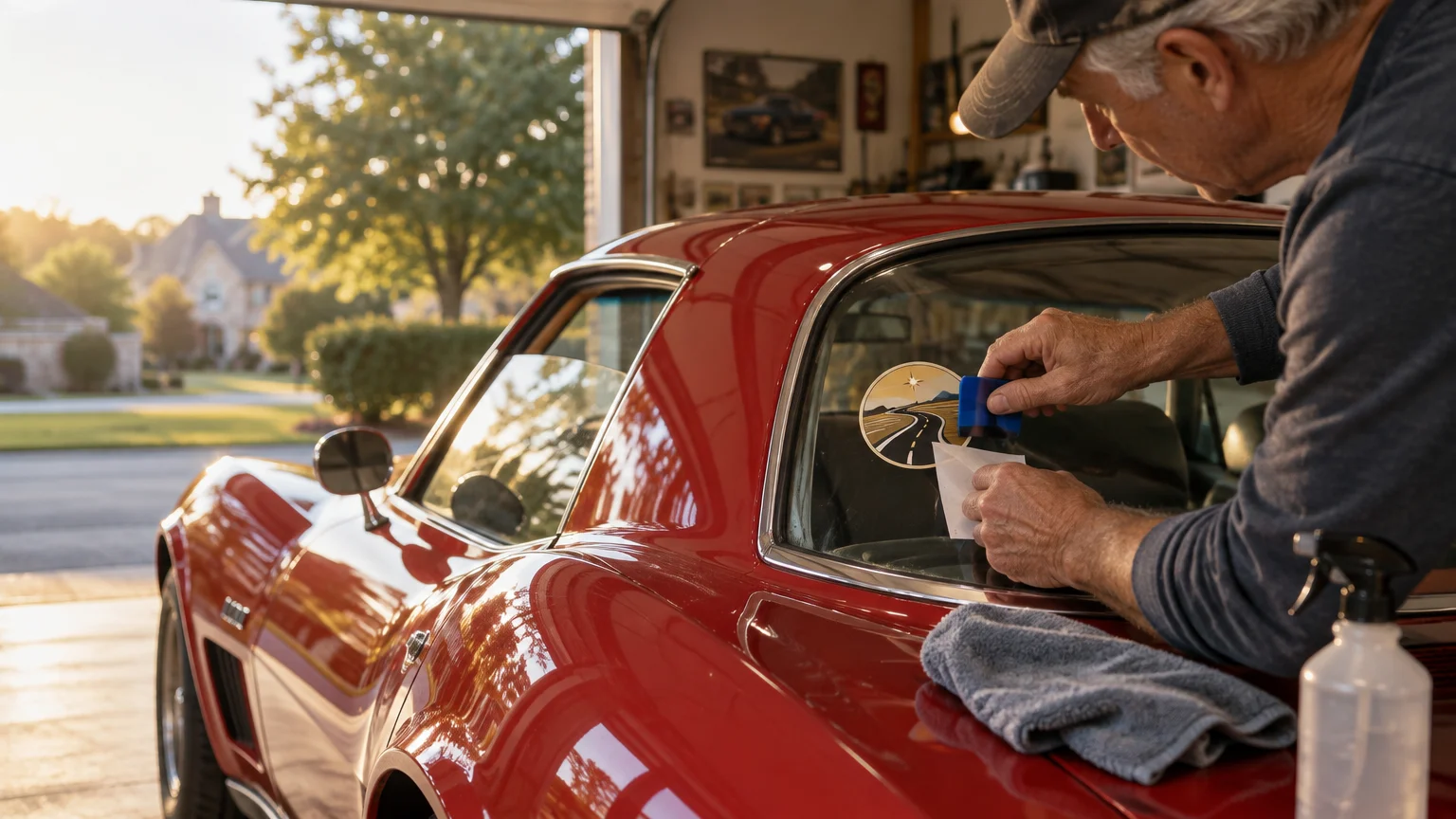
For a small graphic, controlled pressure from the center toward the edges can help avoid trapped air and wrinkles. Cut lettering requires extra care because narrow strokes and small punctuation can lift with the application tape. Do not improvise a wet-installation method unless the product instructions allow it. After installation, inspect edges and corners rather than aggressively washing the car immediately.
Care instructions also vary. For the factory decals and stripes addressed in the 2022 Corvette owner’s manual, Chevrolet recommends lukewarm or cold water, a soft cloth, and car-wash soap. The manual also warns that wax may change the appearance of low-gloss black stripes. That is model-year-specific factory guidance, not a blanket rule for every Corvette or aftermarket vinyl product. Check both the owner’s manual for your car and the decal manufacturer’s instructions.
Removal deserves the same patience as installation. Avery Dennison advises testing a small area when removing permanent-adhesive graphics because results depend on the film and substrate combination. Its bulletin also notes that low temperatures can increase tearing or adhesive residue. Follow the selected product’s directions for temperature, pulling angle, tools, and adhesive removal.
No responsible supplier or installer should promise that every decal will leave every paint finish unharmed. Factory paint in sound condition, an aging repaint, and a panel with failing clear coat present very different risks. If the finish is valuable or uncertain, have an experienced automotive graphics installer or paint professional examine it before installation or removal.
Reproducing a vintage club or event decal responsibly
Old club graphics carry more than a logo. They can record a dealership sponsor, a show date, a local printer’s style, or the visual identity of a particular period. Supplied Easton Area Corvette Club newsletter archives identify 1968 as the club’s founding year; an April 2013 issue calls it the 45th year, while a November 2014 issue calls it the 46th year. Those dated references provide club context, but they do not authenticate the design, dimensions, colors, or ownership of any particular decal.
Treat a reproduction like a small archive project. Begin with the best surviving original or the highest-resolution period image. Photograph or scan it beside a ruler and neutral color reference when possible. Record where it came from, its approximate date, dimensions, material, surface finish, damage, and any known variations.
- Preserve an untouched scan or photograph before cleaning or redrawing anything digitally.
- Transcribe all words, dates, punctuation, and sponsor names exactly as they appear.
- Separate confirmed details from reconstructed sections. A guessed letterform or color should remain documented as a guess.
- Create a proof at actual size. Fine lines that look good on a monitor may be difficult to cut, print, weed, or install.
- Compare cut and printed versions based on the original construction and the intended modern use.
- Confirm permission before reproducing a club name, logo, sponsor mark, or artwork for sale or public distribution.
- Order a small proof before committing to event quantities. A producer of custom vinyl decals and stickers can work from prepared artwork, but the club or project team remains responsible for checking historical details and permissions.
- Store the source scan, working file, final artwork, production notes, and one unused sample together.
If the finished piece combines evidence with modern reconstruction, call it a reproduction or interpretation rather than an original. Add the reproduction date discreetly on the backing card or archive record when changing the visible artwork would be inappropriate. This preserves the pleasure of seeing an old design return without confusing tomorrow’s collector.
The same documentation habits apply to new show graphics. Keep the approved artwork, color references, dimensions, vendor proof, and an unused sample with the event records. Anyone already developing collectible event pieces may find the workflow for designing Corvette show dash plaques useful because it addresses many of the same questions about dates, legibility, proofing, and preservation.
The practical takeaway
A vinyl decal is a purpose-built adhesive graphic, but that simple definition is only the beginning. The sensible choice matches the film and adhesive to the Corvette’s surface, uses cut or printed production according to the artwork, and accounts for installation, washing, and eventual removal before anything touches the car.
For a historic club reproduction, preserve the evidence alongside the graphic. Scan the original, document what is known, mark reconstructed details in the project record, verify permissions, and approve a physical proof. That modest paper trail may become as valuable to a future club historian as the decal itself.
References
- 3M™ Premask Application Tape | 3M United States
- Application: 3M™ Application Tapesfor Graphic Films
- Key components of finished graphics
- 284 Vehicle Care
- Microsoft Word – IB4.10 Removal of Films _Rev 7 12-31-14_
- to Open – the EASTON AREA CORVETTE CLUB
- The President`s Message – the Easton Area Corvette Club – coffee and tea