Tag: Corvette club events

How to Prepare Your Corvette for a Car Show: A Practical Checklist

TLDR

  • Read the event rules before cleaning or changing anything. A casual show-and-shine has different expectations than formal originality judging.
  • Inspect the Corvette’s tires, fluids, lights, battery, latches, and warning indicators before focusing on appearance.
  • Complete the heavy cleaning several days early. Save glass, dust, bugs, and tire touch-ups for the show field.
  • Pay attention to wheels, wheel wells, jambs, exhaust tips, seat creases, engine-bay surfaces, and other areas that are easy to miss.
  • Pack a small show-day detailing kit, registration paperwork, display materials, water, sunscreen, and basic roadside supplies.
  • Keep the display clean and restrained. One useful information board is usually better than a crowded collection of signs and decorations.

A Corvette can look spotless from ten feet away while still carrying brake dust inside the wheels, fingerprints on the glass, dried water in the door jambs, and a fresh collection of bugs across the nose.

The best way to learn how to prepare your Corvette for a car show is to stop thinking only about shine. Good Corvette car show preparation combines mechanical checks, careful detailing, a clean display, and a plan for what happens after the drive to the event.

The goal also depends on the show. A daily-driven C7 entering a participant-voted club event does not need to imitate a factory-correct C2 entering formal originality judging. Both can be presented well. They simply need different preparation plans.

Find Out How the Corvette Show Will Be Judged

Read the registration page and judging rules before doing anything else. Do not assume every Corvette show rewards the same qualities.

Some events are casual displays. Others use public voting, participant ballots, class judges, or detailed restoration standards.

Show FormatWhat Usually Matters MostBest Preparation Approach
Casual show-and-shineCleanliness, overall appearance, and owner interactionFocus on a complete detail and an approachable display
People’s ChoiceVisual impact, color, story, and presentationMake the car easy to understand from a few feet away
Local judged showCondition, cleanliness, workmanship, and class rulesReview the score sheet and prepare every scored area
Originality-based judgingFactory configuration, condition, documentation, and operationResearch the exact year and equipment before replacing parts
Modified classWorkmanship, completeness, condition, and designPresent modifications as a consistent finished build
Display onlyParticipation and enjoymentClean the Corvette without preparing for formal scoring

Formal Corvette judging can be much more specific than a normal club show. National Corvette Restorers Society Flight judging considers both originality and condition. NCRS Open Class judging evaluates operations, interior, exterior, chassis, and mechanical areas without judging factory originality in the same way. The organization also provides sample judging sheets to help owners understand the process.

That distinction matters. Replacing an original but imperfect part with a bright reproduction might improve the appearance of a casual show car while hurting an originality score. Do not “improve” a historically correct Corvette until you understand the class.

For a local event, ask the organizer these questions:

  • Will the car be judged or displayed?
  • Is the class based on generation, year, stock appearance, or modifications?
  • Will the engine compartment be inspected?
  • Are the interior, cargo area, chassis, or undercarriage scored?
  • Must lights, wipers, horn, windows, or other systems operate?
  • Can the owner remain with the car during judging?
  • Is documentation considered?
  • Should the hood, doors, hatch, or convertible top be positioned a certain way?

The club’s guide on how to organize a Corvette car show explains several common judging formats from the organizer’s side.

Use a One-Week Corvette Car Show Preparation Timeline

Trying to complete everything the night before creates rushed decisions. It also increases the chance that you will damage the paint, leave cleaning residue behind, or discover a mechanical problem too late.

A simple timeline works better.

Time Before the ShowMain Tasks
7–10 daysRead the rules, inspect the car, test equipment, and address mechanical concerns
3–5 daysComplete the main wash, paint inspection, wheels, wheel wells, and engine compartment
1–2 daysClean the interior, glass, jambs, exhaust tips, trim, and cargo area
Night beforePack supplies, print paperwork, check the forecast, and confirm the route
Morning of the showCheck tires and fluids, remove garage dust, and load the Corvette carefully
After arrivalRemove road dust and bugs, clean the glass, check the tires, and set up the display

Major paint correction should happen well before the event, especially when you have limited experience with polishing equipment. The evening before a show is not a good time to learn how much clear coat an aggressive pad and compound can remove.

And avoid unnecessary last-minute mechanical changes. A new part may look better, but it can also introduce a leak, warning light, loose connection, or fitment problem.

Inspect the Corvette Before Detailing It

Appearance will not matter much if the Corvette cannot make the trip or leave the show field.

Complete a basic vehicle inspection before starting the deep clean:

  • Check tire condition and cold tire pressure.
  • Look for fluid leaks under the car.
  • Check engine oil, coolant, and other serviceable fluids as appropriate.
  • Test the headlights, brake lights, turn signals, and hazard lights.
  • Check the battery and charging condition.
  • Confirm that the hood, doors, hatch, roof panel, and convertible top operate correctly.
  • Look for loose trim, emblems, spoilers, splitters, and underbody panels.
  • Check for dashboard warnings.
  • Verify that the registration and insurance information are current.
  • Make sure the wheel lock key and roadside equipment are accessible.

Use the pressure and maintenance information for the exact Corvette rather than relying on advice for another generation. Chevrolet provides downloadable owner’s manuals searchable by year, make, and model. Manuals for many newer vehicles are also available through the myChevrolet app or infotainment system.

This matters because cleaning instructions and materials can differ. A convertible top, transparent roof panel, matte stripe, carbon-fiber component, leather surface, and infotainment screen may each require a different product or method.

Wash the Exterior Without Creating New Defects

A car show wash should remove contamination without adding scratches, streaks, or residue.

Work on a cool surface in the shade when possible. Begin by rinsing away loose dirt. Use separate tools for the wheels and painted body so brake dust does not move from the wheels to the paint.

Wash from the cleaner upper surfaces toward the dirtier lower panels. Rinse the wash mitt regularly, and do not allow soap to dry on the car. Dry the Corvette with clean automotive microfiber towels or a suitable vehicle dryer.

Then inspect the areas that collect water:

  • Mirror housings
  • Door handles
  • Hood vents
  • Emblems
  • Fuel door
  • Tail lamps
  • Spoiler mounts
  • Hatch edges
  • Door jambs
  • Convertible-top seals
  • Front grille and splitter openings

Trapped water has a habit of appearing immediately after the car is parked on the show field.

Remove Bugs Carefully

The front bumper, mirrors, windshield, and leading edges may collect insect residue during the trip. Soften the residue with a product that is appropriate for the vehicle’s finish. Do not scrub dried material aggressively.

For show-field touch-ups, a properly lubricated detail spray or waterless wash is generally safer than dragging a dry towel across dusty paint. Use several clean microfiber towels and turn to a fresh section frequently.

A light layer of dust needs a light touch. Gritty road dirt needs a proper wash.

Decide Whether Paint Correction Is Necessary

Paint correction can reduce visible swirl marks, oxidation, and minor defects. But it is not automatically required for every Corvette car show.

Consider correction when:

  • The paint has visible swirls under direct light.
  • Water spots remain after washing.
  • Oxidation has reduced the finish.
  • The car is entering a condition-focused class.
  • You or a professional detailer understand the paint system.

Skip aggressive correction when:

  • The defects are minor.
  • The paint may be thin, old, or historically significant.
  • The show is casual.
  • You are unfamiliar with machine polishing.
  • There is not enough time to test the process safely.

Clean, honest paint often presents better than paint damaged by rushed correction.

Clean the Areas People Actually Notice

Many owners spend most of their time on the hood and fenders. Judges and spectators often notice the neglected areas first.

AreaDetails to Check
Paint and trimBug residue, lower rockers, emblems, vents, grille openings, splitter, and rear fascia
GlassInterior film, fingerprints, edges, mirrors, hatch glass, and streaks visible in sunlight
WheelsFaces, inner barrels, lug recesses, center caps, valve stems, and brake dust
TiresClean sidewalls, even dressing, and no product on the tread
InteriorSeat creases, vents, cupholders, screens, pedals, carpeting, and door panels
Engine areaDust, fingerprints, caps, hoses, painted surfaces, and signs of fluid leakage
JambsDoor hinges, weather seals, hatch channels, sill plates, and trapped water
ExhaustSoot, water spots, and residue around the outlets
Cargo areaLoose objects, dirty mats, cleaning supplies, and exposed wiring or tools

Wheels deserve their own inspection. Brake dust can remain inside the barrel even when the wheel face looks clean. Check the calipers, lug areas, center caps, valve stems, and the visible parts of the wheel wells.

Tire dressing should stay on the sidewall. Apply it evenly and remove the excess before driving. Product on the tread can create a safety problem, while heavy sidewall dressing can sling onto freshly cleaned paint.

Prepare the Engine Compartment Safely

A clean engine compartment can improve the presentation of almost any Corvette, but the process varies by generation.

C1 through C7 Corvettes place the engine at the front. The C8 uses a mid-engine layout, so the accessible areas and display arrangement are different. Modified cars may also have exposed electrical equipment, aftermarket wiring, polished components, or air-intake systems that require special care.

Start with a cool engine. Remove loose debris and dust before applying cleaner. Use small brushes, microfiber towels, and controlled amounts of product rather than flooding the compartment.

Avoid spraying water or cleaner directly into electrical connections, intake openings, fuse areas, exposed filters, or other sensitive components. Consult the owner’s manual or a qualified detailer when you are uncertain about a material or component.

A good engine-bay presentation should look clean and complete. It does not need to look wet. Heavy dressing can attract dust, leave blotches, and create an artificial finish.

This is also the right time to look for:

  • Seepage around caps and reservoirs
  • Loose clamps
  • Frayed wiring
  • Cracked hoses
  • Leaves near vents
  • Missing fasteners
  • Polishing residue
  • Unsecured display pieces

Do not place towels, bottles, signs, or decorations where they could contact hot components.

Make the Interior Look Clean, Not Greasy

The interior should feel like a well-kept Corvette, not a showroom coated in slippery dressing.

Remove receipts, charging cables, drink containers, loose change, garage remotes, and unrelated personal items. Vacuum the carpet, floor mats, seat seams, and cargo area. Use a soft brush or suitable tool around vents, switches, stitching, and narrow trim gaps.

Clean the inside of the windshield carefully. Interior glass film becomes much more visible once the car sits in direct sunlight.

Use interior products that are compatible with the Corvette’s materials. A low-gloss finish generally looks more natural and creates fewer reflections on the windshield.

Do not use slippery dressings on:

  • Steering wheels
  • Shift controls
  • Pedals
  • Seat surfaces that affect driving position
  • Floor mats
  • Frequently handled switches

For a judged event, check the rules before replacing factory floor mats, adding seat covers, or removing original equipment. For a casual display, the main goal is simply a clean and orderly cabin.

Create a Display That Helps People Understand the Car

A strong display answers the questions people are likely to ask without competing with the Corvette.

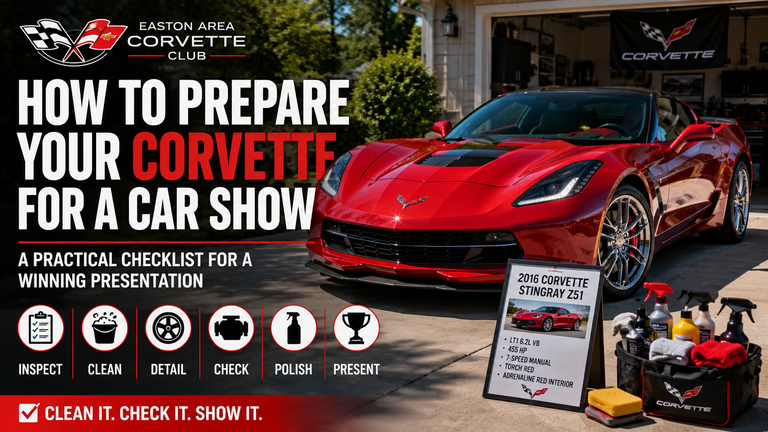
A simple information board can include:

  • Model year and generation
  • Trim or special edition
  • Exterior and interior colors
  • Engine and transmission
  • Factory options
  • Major modifications
  • Restoration history
  • Ownership history
  • A short story about why the car matters to its owner

Keep the text large enough to read from a few feet away. A short summary is more useful than several dense paragraphs.

Restoration photographs can help when the car has undergone substantial work. Previous awards may also be displayed, but they should support the story rather than surround the car like a barricade.

Use a stable sign holder and account for wind. Do not lean a metal frame against the paint or place a display where someone might trip over it.

Add Club Branding Without Covering the Corvette

A club or event sticker can add identity to a show binder, information board, cooler, chair, tool case, or participant packet. CustomStickers.com prints custom vinyl stickers in different shapes and offers an optional digital proof so organizers can review the size and cut line before printing.

Keep giveaway stickers loose. Never apply a sticker directly to another owner’s Corvette, display equipment, glass, or interior without permission.

For event organizers creating participant keepsakes, the club’s guide to designing collectible Corvette dash plaques provides additional sizing and layout guidance.

Pack a Small Corvette Show-Day Kit

You do not need to bring the entire garage. Pack enough to handle road dust, fingerprints, weather changes, and minor problems.

CategoryWhat to Pack
Paint careFinish-safe detail spray or waterless wash and several clean microfiber towels
GlassAutomotive glass cleaner and a dedicated glass towel
Wheels and tiresSmall wheel towel, soft brush, tire applicator, and gloves
InteriorInterior-safe cleaner, soft towel, and small detailing brush
PaperworkRegistration confirmation, class rules, identification, insurance, and event directions
DisplayInformation board, stand, weights, photographs, and participant materials
ComfortFolding chair, water, snacks, sunscreen, hat, umbrella, and light jacket
Roadside itemsPhone charger, jump pack, basic tools, tire equipment, and roadside-assistance details

Car-show packing guides commonly recommend a compact collection of cleaning supplies, display information, basic tools, weather protection, seating, drinks, and sun protection. The right list depends on the age of the Corvette, the distance traveled, and what the event allows.

Store liquids upright and away from the display materials. A leaking bottle of tire dressing can undo a surprising amount of preparation.

And remember that the cargo area may be visible. Use a clean organizer rather than leaving towels, bottles, and tools spread across the trunk.

What to Do After Arriving at the Show

The drive to the event will create a few new problems. Plan for them rather than trying to preserve a flawless detail on public roads.

After parking:

  1. Follow the event staff’s parking instructions.
  2. Confirm the class and entry number.
  3. Allow the brakes, exhaust, and engine area to cool.
  4. Remove fresh bugs from the front surfaces.
  5. Wipe light road dust using a finish-safe product.
  6. Clean the wheels, tires, and visible wheel wells.
  7. Remove fingerprints and streaks from the glass.
  8. Check for water dripping from mirrors, vents, or hatch channels.
  9. Position the hood, hatch, doors, windows, or roof according to the event rules.
  10. Secure the information board and other display materials.
  11. Step back and inspect the entire presentation from several angles.

Do not perform a messy engine detail or spray tire products near neighboring cars. Apply products to a towel or applicator whenever overspray could reach another Corvette.

Once the display is ready, stop touching every surface. Constant adjustments tend to create new fingerprints.

Common Corvette Car Show Preparation Mistakes

Preparing for the Wrong Type of Judging

A casual People’s Choice event and formal originality judging reward different things. Read the rules first.

Cleaning Only the Paint

Dirty glass edges, wheel barrels, door jambs, exhaust outlets, and seat creases can make the rest of the preparation feel incomplete.

Using Too Much Dressing

Heavy shine on tires, dashboards, hoses, and plastic trim can look uneven and attract dust. Apply less and remove the excess.

Dry-Wiping Dust

Dragging a dry towel over dusty paint can create fine scratches. Use a suitable lubricating product or wash the surface properly.

Making Last-Minute Modifications

New lighting, trim, electronics, wheels, or engine parts can create fitment and reliability problems. Finish major work early enough to test the car.

Overloading the Display

Several signs, stuffed animals, flags, ropes, trophies, chairs, and decorations can hide the Corvette. Choose a few useful pieces.

Arguing With Judges

Ask respectful questions when the format permits. Treat a score sheet as information that can improve future preparation rather than a personal verdict on the car.

Forgetting the Drive Home

Leave tire equipment, tools, keys, phone power, and roadside information accessible. Do not bury the wheel lock key beneath the show display.

Conclusion

Learning how to prepare your Corvette for a car show starts with understanding the event. Once you know what will be judged, the rest becomes a manageable sequence: inspect the vehicle, complete the heavy detailing early, clean the overlooked areas, pack a small show-day kit, and finish the presentation after arrival.

Do not chase shine at the expense of safety, originality, or good judgment. A clean daily driver with a clear story can be more engaging than a heavily decorated display that hides the car.

And leave enough time to enjoy the event. Talking with other owners, answering questions, and studying different generations are part of the reason Corvette shows remain worth attending.

How to Organize a Corvette Car Show: A Practical Planning Guide

TLDR

  • Decide what the show is meant to accomplish before choosing the venue, classes, or registration fee.
  • Build the budget around realistic attendance, confirmed sponsors, and a reserve for unexpected costs.
  • Use preregistration data to create fair Corvette classes instead of offering too many nearly empty categories.
  • Map the entrance, show field, emergency lanes, vendors, restrooms, trailer parking, and exit before the first car arrives.
  • Give every major job one clear owner, including registration, parking, judging, sponsors, volunteers, and awards.
  • Publish the judging rules, rain policy, schedule, and vehicle requirements early. Surprises rarely improve a car show.

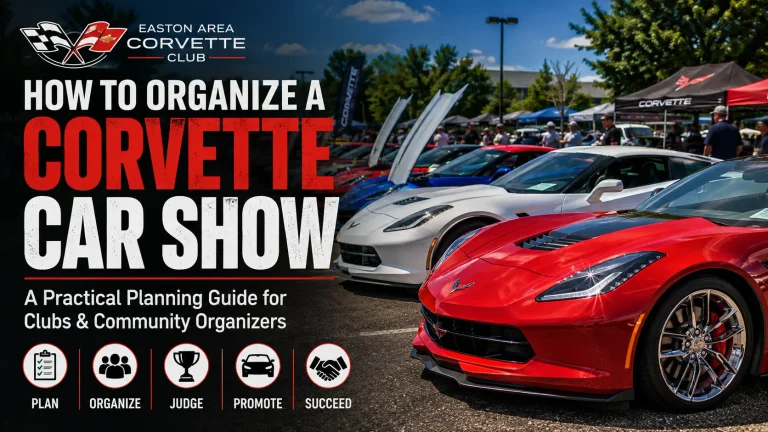
From the spectator side, a Corvette show can look simple. There are rows of polished cars, a few trophies, some music, and people discussing engine options with impressive commitment. Behind the scenes, the event is also a parking operation, registration desk, judging system, fundraising campaign, volunteer project, and public gathering.

If you are learning how to organize a Corvette car show, the easiest approach is to work backward from the experience you want participants to have. Owners should know where to go, how their cars will be judged, when awards will begin, and what happens if the weather changes. Spectators should be able to move through the show safely. Volunteers should understand their jobs without having to find the event chair every five minutes.

That takes planning, but it does not require making the show needlessly complicated. A clear plan usually beats an elaborate one.

How to Organize a Corvette Car Show Around One Clear Goal

Start by deciding what kind of event you are actually planning.

A Corvette car show might be:

  • A charity fundraiser
  • A Corvette club membership event
  • A casual display with participant voting
  • A formal judged show
  • A dealership-sponsored gathering
  • A celebration of one Corvette generation
  • A large public festival with vendors and entertainment

These formats can overlap, but one should remain the priority. A relaxed club gathering becomes harder to manage when a detailed concours-style judging system is added at the last minute. A serious fundraiser may need a different registration fee, sponsor plan, and event layout than a small member social.

Write a one-sentence event brief before spending money:

“A one-day, Corvette-only charity show for up to 150 cars, with generation-based awards, public admission, local vendors, and a simple participant experience.”

That sentence settles several questions. It tells the planning committee who can enter, how large the venue should be, what kind of judging is appropriate, and where the money is supposed to go.

It also gives the committee a way to reject ideas that do not support the main goal. A live band might fit. A second judging system probably does not.

Give Every Major Job One Owner

A committee can provide useful ideas, but a committee should not jointly own every decision. When six people are responsible for registration, no one is fully responsible for registration.

Assign one lead person to each major area:

  • Event chair
  • Venue and show-field layout
  • Registration and payment
  • Judging and awards
  • Sponsors and vendors
  • Volunteers
  • Marketing and communications
  • Finance
  • Safety, insurance, and permits
  • Photography and post-event follow-up

One person may hold more than one role at a smaller show. The important part is that everyone knows who makes the final call.

Keep one shared planning document with confirmed information. It should contain the venue agreement, budget, sponsor commitments, registration totals, award classes, vendor list, volunteer assignments, event schedule, and emergency contacts.

Do not rely on details buried in text messages. That works until someone needs the latest show-field map at 6:30 on a Saturday morning.

Choose a Venue for Cars, Not Just People

A venue can look large until 100 Corvettes, four food trucks, two trailers, a registration tent, and spectator parking arrive.

Walk the property before signing an agreement. Pay attention to:

  • Pavement condition
  • Entrant entrance and exit routes
  • Low curbs and steep transitions
  • Turning room for trailers
  • Separate spectator parking
  • Trailer unloading and storage
  • Restrooms
  • Electrical access
  • Shade and shelter
  • Vendor locations
  • Accessible routes
  • Emergency vehicle access
  • Public-address coverage
  • Cleanup requirements
  • Rain or severe-weather options

Older and lowered Corvettes may have little ground clearance. Inspect driveway angles, speed bumps, broken pavement, drainage channels, and temporary cable covers. A venue that is easy for a pickup truck may not be friendly to a restored C2 or lowered C6.

The show field should also have a controlled entrance. Ideally, every entrant passes through one check-in point before being directed to the correct class. This prevents unregistered cars from entering the field and reduces the chance that a vehicle ends up in the wrong judging group.

In the Easton area, organizers should also check the local event calendar before choosing a date. A competing car show, downtown festival, major sporting event, or road closure can affect attendance, parking, and traffic.

Create a Corvette Car Show Budget Before Setting the Entry Fee

Do not choose the registration fee because another show charges the same amount. Start with the actual costs.

Common expenses include:

  • Venue rental
  • Permits and event insurance
  • Awards and trophies
  • Printing and signage
  • Registration supplies
  • Dash plaques
  • Event stickers and participant gifts
  • Portable restrooms or sanitation
  • Tent, table, and chair rentals
  • Sound equipment
  • Security or traffic assistance
  • Online payment fees
  • Food or drinks for volunteers
  • Waste removal
  • Photography
  • Contingency funds

Separate fixed expenses from per-car expenses. Venue rental is usually fixed. A participant packet, dash plaque, meal ticket, or sticker adds cost each time another car registers.

A basic break-even formula is:

Total expected costs − confirmed sponsorship income ÷ expected paid registrations = break-even registration fee

Suppose the event has $3,000 in expected costs and $1,000 in confirmed sponsor support. With 100 paid cars, the break-even registration amount is $20 per car. Charging $25 could provide a reserve for attendance changes or support the charitable goal.

Do not count sponsor money until the sponsor has committed. And do not describe all registration revenue as a charitable donation when event expenses will be paid from it. State clearly whether the charity receives gross revenue, net proceeds, a fixed donation, or money from specific activities.

Build Corvette Classes From Expected Attendance

Corvette generation classes are easy for participants to understand:

GenerationModel Years
C11953–1962
C21963–1967
C31968–1982
C41984–1996
C51997–2004
C62005–2013
C72014–2019
C82020 and newer, as of September 2026

But eight generation classes are not automatically the right choice. A show expecting 40 cars may end up with one C1, one C2, three C3s, and 20 C8s. Giving every generation the same number of trophies would not create much competition in some classes and could frustrate entrants in others.

Use preregistration totals to make the final structure. Smaller shows can combine generations while preserving reasonable comparisons. Larger shows may divide popular generations into stock-appearing and modified classes.

Define those terms before registration opens. “Modified” should not depend on a judge’s mood. The rules might classify aftermarket body panels, major engine swaps, custom interiors, or nonfactory paint schemes as modified while allowing common wheels and reversible accessories in a stock-appearing class.

Useful special awards can include:

  • Best of Show
  • People’s Choice
  • Club Choice
  • Sponsor’s Choice
  • Best Paint
  • Best Interior
  • Best Engine Compartment
  • Best Custom
  • Longest Distance Driven
  • Best Corvette Story
  • Youth Choice

Do not create so many trophies that each award becomes automatic. A smaller group of meaningful awards usually works better than a ceremony in which nearly every vehicle wins something.

A display-only category is also worth offering. Some owners enjoy attending but do not want their cars scored.

Make Registration Simple and Specific

The registration form should collect only information the event needs:

  • Owner’s name
  • Email and phone number
  • Corvette year
  • Model or trim
  • Stock-appearing or modified status
  • Requested class
  • Club affiliation
  • City and state
  • Shirt size, if relevant
  • Agreement to event rules and waivers
  • Permission preferences for event photography

Include the complete event details on the registration page. Participants should see the address, arrival window, show hours, fee, vehicle eligibility, judging format, refund policy, rain policy, and award schedule before paying.

Send a confirmation immediately after registration. Then send a final participant email several days before the event with:

  • Arrival instructions
  • A map
  • The correct entrance
  • Check-in hours
  • Trailer instructions
  • Judging times
  • Award time
  • Weather updates
  • A contact number for show-day problems

Prepare for weak internet service. Print a registration list, class list, and payment report. Bring blank registration forms, pens, receipt materials, cash-change procedures, and a backup way to accept payments.

Each entrant should receive an entry number and class assignment that can be read easily by judges and parking volunteers. The entry number should match the registration list, judging form, ballot, and award results.

Choose the Right Judging Format

A local Corvette show does not need the same judging system as a national restoration event. It does need a system that participants understand.

Judging FormatWorks Best ForMain Tradeoff
Participant votingSocial club showsFamiliar cars and popular owners may receive more votes
Public People’s ChoiceCommunity eventsVisual impact often matters more than technical quality
Trained judging panelCompetitive local showsRequires preparation, enough judges, and clear score sheets
Concours or originality judgingRestoration-focused eventsRequires specialized knowledge and more time
Display onlyInformal gatheringsProvides no competitive awards

For a trained local judging panel, keep the score sheet manageable. Categories might include exterior, interior, engine compartment, wheels and tires, cleanliness, workmanship, and overall presentation.

Do not score factory originality unless the judges have the knowledge and documentation to do it properly. Formal Corvette judging can involve detailed standards for condition, configuration, installation, mechanical systems, and originality. A general club show should not imply that it is providing the same evaluation unless it has the appropriate expertise.

Before the event, hold a judge briefing. Review:

  • The scoring scale
  • What belongs in each category
  • How modifications will be treated
  • Conflict-of-interest rules
  • Procedures for absent or closed vehicles
  • Tie-breaking rules
  • The judging deadline
  • Who reviews incomplete score sheets

Judges should not evaluate their own cars, family members’ cars, or vehicles they helped build. And the judging rules should not change after entrants arrive.

Map the Entire Show Field

A good show map is not decorative. It is an operating document.

Mark:

  • Entrant entrance
  • Registration checkpoint
  • Corvette parking by class
  • Spectator parking
  • Vendor parking and setup
  • Food trucks
  • Trailer unloading
  • Trailer storage
  • Restrooms
  • Information tent
  • First-aid location
  • Raffle or charity area
  • Stage or announcer
  • Awards display
  • Pedestrian routes
  • Emergency lanes
  • Exit route

SEMA’s event-planning guidance specifically recommends mapping where participants enter, park, and exit while keeping emergency routes and restricted areas clear. Separate vendor instructions are useful because vendor vehicles and setup needs differ from those of show entrants.

Give parking volunteers printed copies of the final map. Use cones, signs, pavement-safe marking tools, or temporary lane markers before the gates open.

Do not allow the first arrivals to invent the layout. Once five cars park incorrectly, every car behind them inherits the problem.

Leave a practical route for early departures. A participant should not need 20 vehicles to move before leaving for a family or mechanical issue.

Make Sponsors Useful to the Event

Sponsors are easier to retain when the benefits are specific.

A sponsorship package might include:

  • Logo on the event page
  • Logo on selected printed materials
  • Display space at the show
  • Announcer recognition
  • Social media recognition
  • Registration-packet insert
  • Sponsored award
  • Banner placement
  • Complimentary vehicle registrations
  • Inclusion in the post-event thank-you

Do not promise “maximum exposure” or other vague benefits. Tell each sponsor exactly what it receives and when artwork is due.

Ask for vector logos when possible. PDF, AI, EPS, and SVG files usually reproduce more cleanly than small images copied from a website. Set one final artwork deadline. Late logos can go on the website or sponsor board rather than delaying every printed piece.

If the event supports a charity, put the relationship in writing. Confirm who collects the money, what expenses are deducted, when funds are transferred, and how the final amount will be reported.

Raffles and 50/50 drawings may be regulated under Pennsylvania’s small-games-of-chance rules. Organizers should confirm eligibility, licensing, recordkeeping, prize, and ticket requirements before selling entries. A charitable purpose does not automatically remove those requirements.

Build Registration Packets People Will Use

A participant packet can make check-in feel organized without becoming a bag of disposable advertising.

Useful items include:

  • Show-field map
  • Event schedule
  • Entry number or dash card
  • Judging information
  • People’s Choice ballot
  • Sponsor offers
  • Charity information
  • Dash plaque
  • Event sticker
  • Short thank-you note

The site’s guide to designing collectible Corvette dash plaques explains how to create a keepsake that records the event without turning the plaque into a miniature flyer.

A custom event sticker is another practical addition. A 2.5- to 3-inch die-cut design can include the event name, year, club name, and one clear Corvette-inspired image. CustomStickers.com offers custom vinyl stickers with online proofing, which gives organizers a chance to review the shape, cut line, spelling, and small details before production.

Keep the sticker useful after the show. Avoid filling it with sponsor logos or temporary instructions. Owners may place it on a garage cabinet, cooler, water bottle, trailer box, display board, or other smooth surface.

And hand the sticker out loose. Volunteers should never apply decals directly to an entrant’s paint, glass, restored interior, or other vehicle surface.

Official Corvette names, emblems, crossed-flags designs, and vehicle imagery may involve General Motors intellectual property. Before printing official brand elements on stickers, shirts, plaques, or merchandise, review GM’s licensing requirements and obtain permission where required. An original club design or properly licensed illustration can prevent an avoidable problem.

Promote One Reliable Source of Information

Create one event page containing the final details. Flyers, social posts, emails, and event listings should all direct people back to that page.

The event page should answer:

  • What vehicles can register?
  • Is the event Corvette-only?
  • How much does registration cost?
  • Can participants register on show day?
  • When do gates open?
  • When does registration close?
  • How are cars judged?
  • What awards are offered?
  • Is spectator admission free?
  • Is the event rain or shine?
  • Where should trailers enter?
  • Which charity benefits?
  • Are pets permitted?
  • Who can answer questions?

Promote the show through local Corvette clubs, dealerships, restoration shops, detailers, automotive businesses, community calendars, local media, and relevant social groups.

But do not post slightly different details in ten places. An old flyer with the wrong gate time will continue circulating long after the corrected version appears.

Use the same event name, artwork, date, and registration link everywhere. Consistency looks better and reduces questions.

Write a Show-Day Schedule

The schedule should cover volunteers as well as participants.

A sample structure might look like this:

TimeActivity
2 hours before gatesTents, signs, cones, registration, sound, awards, and vendor checks
60–90 minutes before gatesVolunteer and judge briefings
Gates openRegistration and directed parking begin
MidmorningWelcome announcement and judging reminder
Registration cutoffFinal class lists sent to judges
Judging periodJudges score assigned classes
Ballot cutoffPeople’s Choice votes collected and counted
Before awardsScores checked, ties resolved, winners confirmed
AwardsWinners announced in a fixed order
After awardsControlled departure and cleanup
Final walkthroughTrash, equipment, signs, and venue condition checked

Adjust the times to fit the size of the event. The important point is that every deadline has an owner.

Prepare short announcements in advance. Include registration closing, judging beginning, ballot deadlines, raffle information, charity updates, safety reminders, and the award time.

Do not make volunteers guess what should be announced or when.

Plan for Weather, Safety, Insurance, and Permits

Weather decisions should be made before the event is promoted.

Choose one policy:

  • Rain or shine
  • Rain date
  • Cancellation with refunds
  • Cancellation with registration transferred to a future event
  • Indoor or covered backup plan

Publish the policy on the registration page and confirmation email. Explain who makes the final weather decision and where updates will appear.

The safety plan should address:

  • Emergency access
  • First aid
  • Heat and hydration
  • Severe weather
  • Fire extinguishers
  • Fuel or fluid spills
  • Lost children
  • Traffic conflicts
  • Vendor equipment
  • Tent anchoring
  • Incident reporting
  • Early vehicle departures

Permit and insurance requirements vary by property, activity, municipality, attendance, food service, street use, and entertainment. Confirm them with the venue, insurer, and relevant local authorities. The City of Easton maintains current licensing and permit resources that organizers can review when considering an event inside the city.

This paperwork is not the exciting part of a Corvette show. It is still part of running one responsibly.

Use a Six-Month Planning Timeline

A smaller event may need less time. A large charity show may need more. This schedule gives a club a practical starting point.

Six Months or More Before

Set the purpose, date, venue, estimated capacity, charity relationship, event chair, and core committee. Begin permit and insurance discussions.

Four to Five Months Before

Approve the budget, entry rules, sponsor packages, vendor plan, judging format, and preliminary classes. Contact major sponsors and judges.

Three Months Before

Open registration. Publish the event page. Begin promotion. Develop the show-field map. Start designing awards, signs, dash plaques, and stickers.

Six to Eight Weeks Before

Review preregistration by generation and class. Recruit parking, registration, judging, setup, and cleanup volunteers. Confirm food and other vendors.

Two to Four Weeks Before

Finalize classes, award quantities, sponsor artwork, signage, participant materials, and volunteer assignments. Order or print all remaining materials.

One Week Before

Send participant instructions. Print backup lists and maps. Assemble registration packets. Hold the final committee meeting. Review the weather and communication plan.

The Day Before

Confirm the venue, vendors, tents, equipment, awards, cash procedures, supplies, radios, signage, and contact list.

Within Two Days After

Thank volunteers, sponsors, vendors, and participants. Publish confirmed winners. Reconcile finances. Begin the charity transfer process. Record lessons while everyone still remembers what happened.

Common Corvette Car Show Planning Mistakes

Promoting Before the Venue Is Confirmed

A tentative date has a way of becoming a permanent screenshot. Confirm the agreement first.

Offering Too Many Classes

Classes should reflect likely attendance. One car competing alone is a display category with a trophy.

Leaving the Arrival Route Unmarked

Participants should see the next direction before they need it. Place signs far enough ahead to prevent abrupt turns and traffic backups.

Failing to Prepare an Offline Registration List

A weak signal should not stop the entire entrance line.

Ordering Printed Materials Too Early

Wait until the date, sponsors, charity wording, and artwork are final. Then leave enough time for proofing and production.

Hiding the Rain Policy

Participants should not need to search social media on the morning of the event to learn whether the show is happening.

Treating Judging Rules as Flexible

Rules that change during the show will look unfair, even when the organizers mean well.

Putting Every Responsibility on One Person

The event chair should solve unusual problems. The chair should not also be the only person who knows how registration, awards, and vendor placement work.

FAQs

How Far in Advance Should a Corvette Car Show Be Planned?

A local show should typically begin planning several months ahead. Six months is a practical starting point when the event needs a venue, sponsors, permits, insurance, awards, vendors, and a large volunteer team.

How Much Should Corvette Car Show Registration Cost?

Set the fee from the event budget, expected turnout, confirmed sponsorship, participant items, and fundraising goal. Local competitor pricing can provide context, but it should not replace the budget calculation.

What Are the Best Classes for a Corvette Show?

Generation-based classes from C1 through C8 are easy to understand. The final structure should reflect preregistration totals. Popular generations may need stock-appearing and modified divisions, while lightly represented generations may need to be combined.

Is Participant Voting Better Than Formal Judging?

Participant voting is easier to manage and fits a social event. A trained judging panel usually produces more consistent technical results. The better choice depends on the event’s purpose and the experience of the available judges.

How Many Volunteers Does a Car Show Need?

There is no fixed number. A 100-car show might need separate teams for setup, registration, parking, judging, ballot counting, information, awards, traffic, and cleanup. List the positions first, then recruit enough people to cover each job without relying on one volunteer in two places at once.

Does a Corvette Car Show Need Insurance and Permits?

Many events do, but the requirements depend on the venue and activities. Check with the property owner, insurance provider, municipality, and any agencies responsible for streets, food service, raffles, tents, or public gatherings.

Conclusion

Learning how to organize a Corvette car show is mostly about settling important details before they become show-day problems.

Begin with one clear purpose. Choose a venue that works for low sports cars, trailers, spectators, and emergency access. Build a real budget. Let expected attendance shape the classes. Publish the judging rules, arrival instructions, schedule, and weather policy before anyone registers.

Then make the experience memorable in a restrained way. A useful registration packet, a well-designed dash plaque, and a clean event sticker will usually mean more than a bag filled with unrelated promotional items.

A successful Corvette show should feel simple to the participant. That simplicity is the result of organized work happening well before the first engine starts.