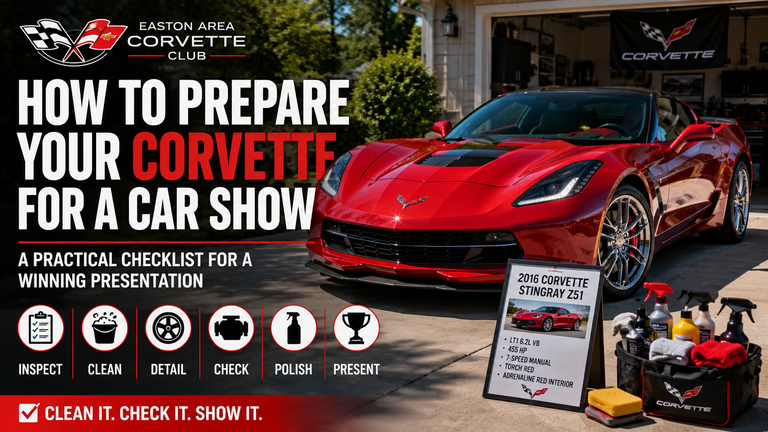
TLDR
- Read the event rules before cleaning or changing anything. A casual show-and-shine has different expectations than formal originality judging.
- Inspect the Corvette’s tires, fluids, lights, battery, latches, and warning indicators before focusing on appearance.
- Complete the heavy cleaning several days early. Save glass, dust, bugs, and tire touch-ups for the show field.
- Pay attention to wheels, wheel wells, jambs, exhaust tips, seat creases, engine-bay surfaces, and other areas that are easy to miss.
- Pack a small show-day detailing kit, registration paperwork, display materials, water, sunscreen, and basic roadside supplies.
- Keep the display clean and restrained. One useful information board is usually better than a crowded collection of signs and decorations.
A Corvette can look spotless from ten feet away while still carrying brake dust inside the wheels, fingerprints on the glass, dried water in the door jambs, and a fresh collection of bugs across the nose.
The best way to learn how to prepare your Corvette for a car show is to stop thinking only about shine. Good Corvette car show preparation combines mechanical checks, careful detailing, a clean display, and a plan for what happens after the drive to the event.
The goal also depends on the show. A daily-driven C7 entering a participant-voted club event does not need to imitate a factory-correct C2 entering formal originality judging. Both can be presented well. They simply need different preparation plans.
Find Out How the Corvette Show Will Be Judged
Read the registration page and judging rules before doing anything else. Do not assume every Corvette show rewards the same qualities.
Some events are casual displays. Others use public voting, participant ballots, class judges, or detailed restoration standards.
| Show Format | What Usually Matters Most | Best Preparation Approach |
|---|---|---|
| Casual show-and-shine | Cleanliness, overall appearance, and owner interaction | Focus on a complete detail and an approachable display |
| People’s Choice | Visual impact, color, story, and presentation | Make the car easy to understand from a few feet away |
| Local judged show | Condition, cleanliness, workmanship, and class rules | Review the score sheet and prepare every scored area |
| Originality-based judging | Factory configuration, condition, documentation, and operation | Research the exact year and equipment before replacing parts |
| Modified class | Workmanship, completeness, condition, and design | Present modifications as a consistent finished build |
| Display only | Participation and enjoyment | Clean the Corvette without preparing for formal scoring |
Formal Corvette judging can be much more specific than a normal club show. National Corvette Restorers Society Flight judging considers both originality and condition. NCRS Open Class judging evaluates operations, interior, exterior, chassis, and mechanical areas without judging factory originality in the same way. The organization also provides sample judging sheets to help owners understand the process.
That distinction matters. Replacing an original but imperfect part with a bright reproduction might improve the appearance of a casual show car while hurting an originality score. Do not “improve” a historically correct Corvette until you understand the class.
For a local event, ask the organizer these questions:
- Will the car be judged or displayed?
- Is the class based on generation, year, stock appearance, or modifications?
- Will the engine compartment be inspected?
- Are the interior, cargo area, chassis, or undercarriage scored?
- Must lights, wipers, horn, windows, or other systems operate?
- Can the owner remain with the car during judging?
- Is documentation considered?
- Should the hood, doors, hatch, or convertible top be positioned a certain way?
The club’s guide on how to organize a Corvette car show explains several common judging formats from the organizer’s side.
Use a One-Week Corvette Car Show Preparation Timeline
Trying to complete everything the night before creates rushed decisions. It also increases the chance that you will damage the paint, leave cleaning residue behind, or discover a mechanical problem too late.
A simple timeline works better.
| Time Before the Show | Main Tasks |
|---|---|
| 7–10 days | Read the rules, inspect the car, test equipment, and address mechanical concerns |
| 3–5 days | Complete the main wash, paint inspection, wheels, wheel wells, and engine compartment |
| 1–2 days | Clean the interior, glass, jambs, exhaust tips, trim, and cargo area |
| Night before | Pack supplies, print paperwork, check the forecast, and confirm the route |
| Morning of the show | Check tires and fluids, remove garage dust, and load the Corvette carefully |
| After arrival | Remove road dust and bugs, clean the glass, check the tires, and set up the display |
Major paint correction should happen well before the event, especially when you have limited experience with polishing equipment. The evening before a show is not a good time to learn how much clear coat an aggressive pad and compound can remove.
And avoid unnecessary last-minute mechanical changes. A new part may look better, but it can also introduce a leak, warning light, loose connection, or fitment problem.
Inspect the Corvette Before Detailing It
Appearance will not matter much if the Corvette cannot make the trip or leave the show field.
Complete a basic vehicle inspection before starting the deep clean:
- Check tire condition and cold tire pressure.
- Look for fluid leaks under the car.
- Check engine oil, coolant, and other serviceable fluids as appropriate.
- Test the headlights, brake lights, turn signals, and hazard lights.
- Check the battery and charging condition.
- Confirm that the hood, doors, hatch, roof panel, and convertible top operate correctly.
- Look for loose trim, emblems, spoilers, splitters, and underbody panels.
- Check for dashboard warnings.
- Verify that the registration and insurance information are current.
- Make sure the wheel lock key and roadside equipment are accessible.
Use the pressure and maintenance information for the exact Corvette rather than relying on advice for another generation. Chevrolet provides downloadable owner’s manuals searchable by year, make, and model. Manuals for many newer vehicles are also available through the myChevrolet app or infotainment system.
This matters because cleaning instructions and materials can differ. A convertible top, transparent roof panel, matte stripe, carbon-fiber component, leather surface, and infotainment screen may each require a different product or method.
Wash the Exterior Without Creating New Defects
A car show wash should remove contamination without adding scratches, streaks, or residue.
Work on a cool surface in the shade when possible. Begin by rinsing away loose dirt. Use separate tools for the wheels and painted body so brake dust does not move from the wheels to the paint.
Wash from the cleaner upper surfaces toward the dirtier lower panels. Rinse the wash mitt regularly, and do not allow soap to dry on the car. Dry the Corvette with clean automotive microfiber towels or a suitable vehicle dryer.
Then inspect the areas that collect water:
- Mirror housings
- Door handles
- Hood vents
- Emblems
- Fuel door
- Tail lamps
- Spoiler mounts
- Hatch edges
- Door jambs
- Convertible-top seals
- Front grille and splitter openings
Trapped water has a habit of appearing immediately after the car is parked on the show field.
Remove Bugs Carefully
The front bumper, mirrors, windshield, and leading edges may collect insect residue during the trip. Soften the residue with a product that is appropriate for the vehicle’s finish. Do not scrub dried material aggressively.
For show-field touch-ups, a properly lubricated detail spray or waterless wash is generally safer than dragging a dry towel across dusty paint. Use several clean microfiber towels and turn to a fresh section frequently.
A light layer of dust needs a light touch. Gritty road dirt needs a proper wash.
Decide Whether Paint Correction Is Necessary
Paint correction can reduce visible swirl marks, oxidation, and minor defects. But it is not automatically required for every Corvette car show.
Consider correction when:
- The paint has visible swirls under direct light.
- Water spots remain after washing.
- Oxidation has reduced the finish.
- The car is entering a condition-focused class.
- You or a professional detailer understand the paint system.
Skip aggressive correction when:
- The defects are minor.
- The paint may be thin, old, or historically significant.
- The show is casual.
- You are unfamiliar with machine polishing.
- There is not enough time to test the process safely.
Clean, honest paint often presents better than paint damaged by rushed correction.
Clean the Areas People Actually Notice
Many owners spend most of their time on the hood and fenders. Judges and spectators often notice the neglected areas first.
| Area | Details to Check |
|---|---|
| Paint and trim | Bug residue, lower rockers, emblems, vents, grille openings, splitter, and rear fascia |
| Glass | Interior film, fingerprints, edges, mirrors, hatch glass, and streaks visible in sunlight |
| Wheels | Faces, inner barrels, lug recesses, center caps, valve stems, and brake dust |
| Tires | Clean sidewalls, even dressing, and no product on the tread |
| Interior | Seat creases, vents, cupholders, screens, pedals, carpeting, and door panels |
| Engine area | Dust, fingerprints, caps, hoses, painted surfaces, and signs of fluid leakage |
| Jambs | Door hinges, weather seals, hatch channels, sill plates, and trapped water |
| Exhaust | Soot, water spots, and residue around the outlets |
| Cargo area | Loose objects, dirty mats, cleaning supplies, and exposed wiring or tools |
Wheels deserve their own inspection. Brake dust can remain inside the barrel even when the wheel face looks clean. Check the calipers, lug areas, center caps, valve stems, and the visible parts of the wheel wells.
Tire dressing should stay on the sidewall. Apply it evenly and remove the excess before driving. Product on the tread can create a safety problem, while heavy sidewall dressing can sling onto freshly cleaned paint.
Prepare the Engine Compartment Safely
A clean engine compartment can improve the presentation of almost any Corvette, but the process varies by generation.
C1 through C7 Corvettes place the engine at the front. The C8 uses a mid-engine layout, so the accessible areas and display arrangement are different. Modified cars may also have exposed electrical equipment, aftermarket wiring, polished components, or air-intake systems that require special care.
Start with a cool engine. Remove loose debris and dust before applying cleaner. Use small brushes, microfiber towels, and controlled amounts of product rather than flooding the compartment.
Avoid spraying water or cleaner directly into electrical connections, intake openings, fuse areas, exposed filters, or other sensitive components. Consult the owner’s manual or a qualified detailer when you are uncertain about a material or component.
A good engine-bay presentation should look clean and complete. It does not need to look wet. Heavy dressing can attract dust, leave blotches, and create an artificial finish.
This is also the right time to look for:
- Seepage around caps and reservoirs
- Loose clamps
- Frayed wiring
- Cracked hoses
- Leaves near vents
- Missing fasteners
- Polishing residue
- Unsecured display pieces
Do not place towels, bottles, signs, or decorations where they could contact hot components.
Make the Interior Look Clean, Not Greasy
The interior should feel like a well-kept Corvette, not a showroom coated in slippery dressing.
Remove receipts, charging cables, drink containers, loose change, garage remotes, and unrelated personal items. Vacuum the carpet, floor mats, seat seams, and cargo area. Use a soft brush or suitable tool around vents, switches, stitching, and narrow trim gaps.
Clean the inside of the windshield carefully. Interior glass film becomes much more visible once the car sits in direct sunlight.
Use interior products that are compatible with the Corvette’s materials. A low-gloss finish generally looks more natural and creates fewer reflections on the windshield.
Do not use slippery dressings on:
- Steering wheels
- Shift controls
- Pedals
- Seat surfaces that affect driving position
- Floor mats
- Frequently handled switches
For a judged event, check the rules before replacing factory floor mats, adding seat covers, or removing original equipment. For a casual display, the main goal is simply a clean and orderly cabin.
Create a Display That Helps People Understand the Car
A strong display answers the questions people are likely to ask without competing with the Corvette.
A simple information board can include:
- Model year and generation
- Trim or special edition
- Exterior and interior colors
- Engine and transmission
- Factory options
- Major modifications
- Restoration history
- Ownership history
- A short story about why the car matters to its owner
Keep the text large enough to read from a few feet away. A short summary is more useful than several dense paragraphs.
Restoration photographs can help when the car has undergone substantial work. Previous awards may also be displayed, but they should support the story rather than surround the car like a barricade.
Use a stable sign holder and account for wind. Do not lean a metal frame against the paint or place a display where someone might trip over it.
Add Club Branding Without Covering the Corvette
A club or event sticker can add identity to a show binder, information board, cooler, chair, tool case, or participant packet. CustomStickers.com prints custom vinyl stickers in different shapes and offers an optional digital proof so organizers can review the size and cut line before printing.
Keep giveaway stickers loose. Never apply a sticker directly to another owner’s Corvette, display equipment, glass, or interior without permission.
For event organizers creating participant keepsakes, the club’s guide to designing collectible Corvette dash plaques provides additional sizing and layout guidance.
Pack a Small Corvette Show-Day Kit
You do not need to bring the entire garage. Pack enough to handle road dust, fingerprints, weather changes, and minor problems.
| Category | What to Pack |
|---|---|
| Paint care | Finish-safe detail spray or waterless wash and several clean microfiber towels |
| Glass | Automotive glass cleaner and a dedicated glass towel |
| Wheels and tires | Small wheel towel, soft brush, tire applicator, and gloves |
| Interior | Interior-safe cleaner, soft towel, and small detailing brush |
| Paperwork | Registration confirmation, class rules, identification, insurance, and event directions |
| Display | Information board, stand, weights, photographs, and participant materials |
| Comfort | Folding chair, water, snacks, sunscreen, hat, umbrella, and light jacket |
| Roadside items | Phone charger, jump pack, basic tools, tire equipment, and roadside-assistance details |
Car-show packing guides commonly recommend a compact collection of cleaning supplies, display information, basic tools, weather protection, seating, drinks, and sun protection. The right list depends on the age of the Corvette, the distance traveled, and what the event allows.
Store liquids upright and away from the display materials. A leaking bottle of tire dressing can undo a surprising amount of preparation.
And remember that the cargo area may be visible. Use a clean organizer rather than leaving towels, bottles, and tools spread across the trunk.
What to Do After Arriving at the Show
The drive to the event will create a few new problems. Plan for them rather than trying to preserve a flawless detail on public roads.
After parking:
- Follow the event staff’s parking instructions.
- Confirm the class and entry number.
- Allow the brakes, exhaust, and engine area to cool.
- Remove fresh bugs from the front surfaces.
- Wipe light road dust using a finish-safe product.
- Clean the wheels, tires, and visible wheel wells.
- Remove fingerprints and streaks from the glass.
- Check for water dripping from mirrors, vents, or hatch channels.
- Position the hood, hatch, doors, windows, or roof according to the event rules.
- Secure the information board and other display materials.
- Step back and inspect the entire presentation from several angles.
Do not perform a messy engine detail or spray tire products near neighboring cars. Apply products to a towel or applicator whenever overspray could reach another Corvette.
Once the display is ready, stop touching every surface. Constant adjustments tend to create new fingerprints.
Common Corvette Car Show Preparation Mistakes
Preparing for the Wrong Type of Judging
A casual People’s Choice event and formal originality judging reward different things. Read the rules first.
Cleaning Only the Paint
Dirty glass edges, wheel barrels, door jambs, exhaust outlets, and seat creases can make the rest of the preparation feel incomplete.
Using Too Much Dressing
Heavy shine on tires, dashboards, hoses, and plastic trim can look uneven and attract dust. Apply less and remove the excess.
Dry-Wiping Dust
Dragging a dry towel over dusty paint can create fine scratches. Use a suitable lubricating product or wash the surface properly.
Making Last-Minute Modifications
New lighting, trim, electronics, wheels, or engine parts can create fitment and reliability problems. Finish major work early enough to test the car.
Overloading the Display
Several signs, stuffed animals, flags, ropes, trophies, chairs, and decorations can hide the Corvette. Choose a few useful pieces.
Arguing With Judges
Ask respectful questions when the format permits. Treat a score sheet as information that can improve future preparation rather than a personal verdict on the car.
Forgetting the Drive Home
Leave tire equipment, tools, keys, phone power, and roadside information accessible. Do not bury the wheel lock key beneath the show display.
Conclusion
Learning how to prepare your Corvette for a car show starts with understanding the event. Once you know what will be judged, the rest becomes a manageable sequence: inspect the vehicle, complete the heavy detailing early, clean the overlooked areas, pack a small show-day kit, and finish the presentation after arrival.
Do not chase shine at the expense of safety, originality, or good judgment. A clean daily driver with a clear story can be more engaging than a heavily decorated display that hides the car.
And leave enough time to enjoy the event. Talking with other owners, answering questions, and studying different generations are part of the reason Corvette shows remain worth attending.